
 TrafficTriage
How I Got My First Clicks From Google, Starting at Zero
By Ugur Saritepe · August 13, 2026
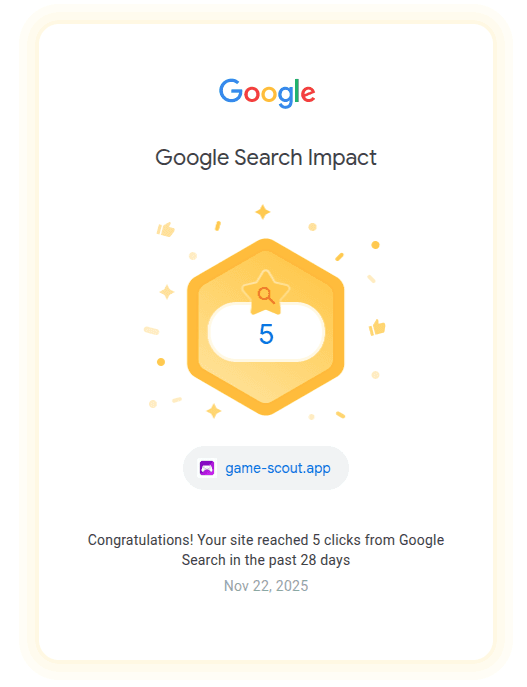
My first clicks from Google did not come from my homepage, and they did not come from any SEO trick. They came from a single oddly specific page — a list of medical games — that matched a search almost nobody else was competing for. I launched game-scout.app, watched Search Console show nothing for weeks (most pages parked at Discovered - currently not indexed), and then one day in late November 2025 got an email: 5 clicks. Today the same site pulls past 1,000 clicks a month, and every one of them traces back to the pattern those first five taught me.
What actually earned the first clicks
The first clicks came from one page: /best/best-medical-games. Not the homepage, not the game search tool I had spent all my time on — a plain list of medical-themed games. Google emailed me a milestone badge the day it crossed five clicks in a rolling 28-day window.
When I opened the report, the picture was unambiguous. Over November and December 2025 the whole site got 50 clicks from 2,941 impressions — and 46 of those 50 clicks landed on that one medical-games page. The searches behind them were as specific as the page:
medical games ps5— 5 clicks, average position 7.6ps5 medical games— 3 clicks, average position 7.4doctor games ps5— 1 click, position 5
Here is the honest part: that page only existed by accident. While building the site I needed a test search I could type over and over, and my wife had once complained that no game site returned anything for “medical games.” So medical games became my default test query, and at some point I gave it its own page. It was never meant to be the star. It just happened to be the one specific thing on the whole site that a real person was searching for.
Why a weird niche page beat the homepage
A brand-new site has no authority, so it can only win searches where the competition is thin and the page is genuinely the best answer. My homepage — a game filtering tool — was competing against every established gaming site for broad terms like “ps5 games,” a fight it had no chance of winning. The medical-games list was competing against almost nobody, for a search with a crystal-clear intent, on a page that actually answered it.
That is the whole mechanism. Long-tail searches — the specific, several-word ones — have less competition and clearer intent, which means a new page can realistically be the most complete answer and rank. Broad searches are already owned by sites with years of authority. At zero, specific beats broad every time, and it is not close.
Then it stalled, and I quit for two months
Getting the pattern right once did not make me disciplined about it. In January 2026 I did the obvious wrong thing: I added a pile of new pages as fast as I could, assuming more pages meant more clicks. Impressions went up, but average position collapsed and clicks slid back to where they started.
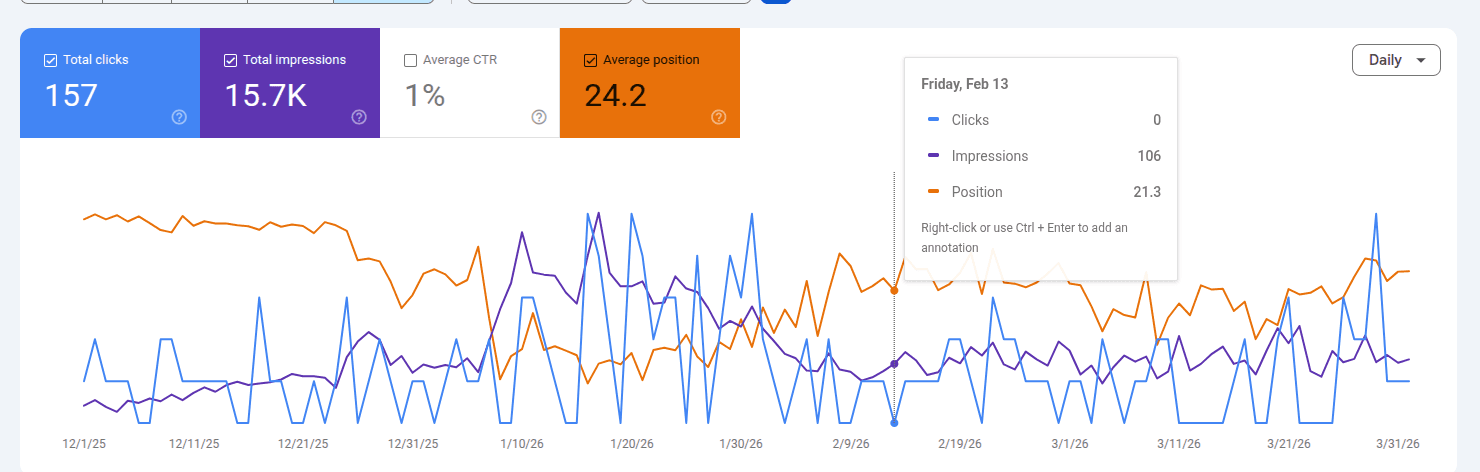
Google Search Console, monthly
Dec 2025:  30 clicks   2,268 impressions   position 12.5
Jan 2026:  63 clicks   6,606 impressions   position 31.1  (impressions up, position wrecked)
Feb 2026:  30 clicks   3,146 impressions   position 20.2
Mar 2026:  33 clicks   3,577 impressions   position 22.6
It felt like working for nothing, so I stopped. February and March I did not touch the project at all — the commit history is two empty months. The mistake was treating volume as the goal. Twenty thin pages competing for terms I could not win did worse than one specific page that answered a real search.
The comeback: fewer pages, made genuinely better
When I came back in April, I did not add a single new page. I improved the handful that already had at least one click. Those pages had already proven a real person was searching for them — the only thing missing was being the best answer once they arrived.
So for each of those pages I:
- Replaced the auto-generated game lists with hand-curated ones and removed the games that did not belong.
- Added real data per game — proper details, reviews, and a short reason each game earned its spot on the list.
- Rebuilt the weakest pages sitting just off the first page of results, since those were the closest to breaking through.
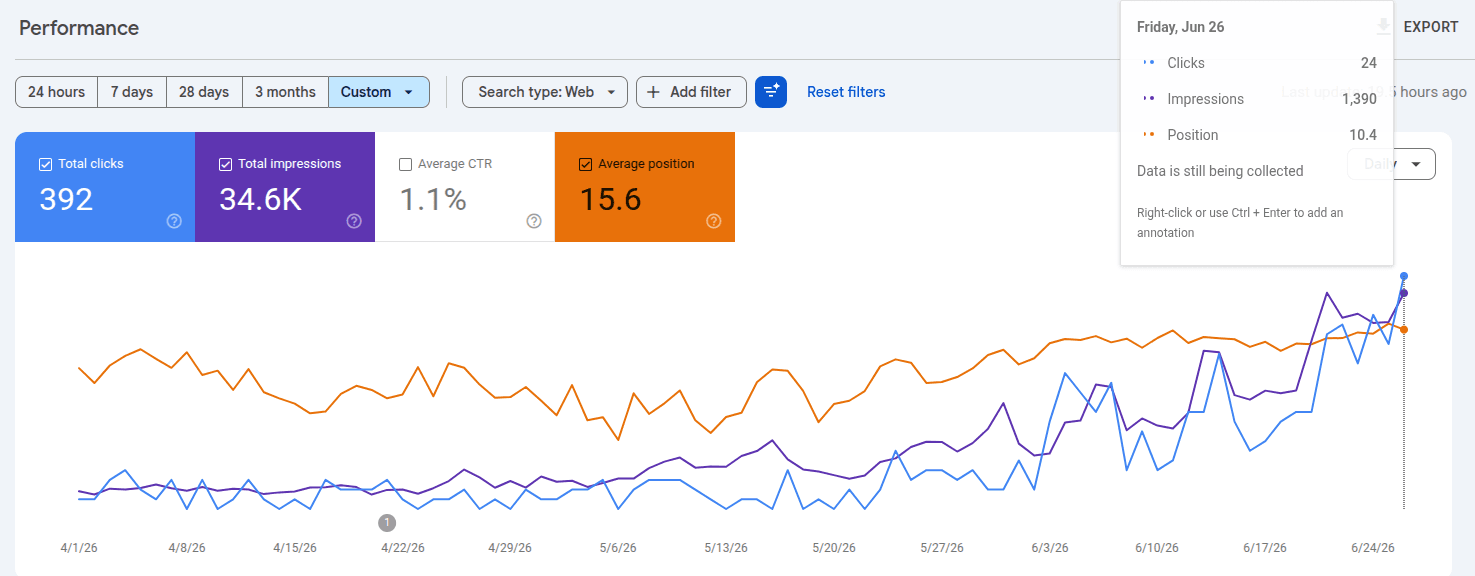
The line turned and kept going. The site went from bouncing around 30 clicks a month to past 1,000, without adding pages — just by making the proven ones worth ranking.
Google Search Console
Jan 2026:            63 clicks     6,606 impressions   position 31.1
Last 28 days (Aug):  1,066 clicks  51,643 impressions  position 10.3
And the pattern from those first five clicks repeated at every rung. Here is the per-page breakdown from when this section was first written, July 2026 — still niche lists, not the homepage:
Top pages, 30 days as of Jul 2026 (clicks / avg pos)
best-medieval-fantasy-games   127   pos 8.0
best-medical-games             73   pos 6.2
best-trucking-games            37   pos 8.5
best-local-coop-games          29   pos 15.8
best-coop-rpg-games            26   pos 14.2
The medical-games page that earned the first five clicks now ranks at position 2 for its main search. It was never the biggest page — it was the most specific, and specific is what a new site can actually win.
The long tail doesn’t just rank easier — it converts harder
Everything above is about ranking: a niche page can win a position a homepage never could. What I had not checked until now is whether those niche rankings also turn into clicks at a higher rate. They do.
Query, 28 days to Aug 13 2026 (clicks/CTR/pos)
best truck simulator ps5    24   6.8%   5.7
best detective games ps5    13  11.6%   5.7
best mystery games ps5       8  15.1%   5.2
cleaning games on ps5        5  22.7%   4.2
medical games ps5            3  11.5%  3.65
Site-wide CTR over the same 28 days is 2.06%. Every query in that table converts at 3 to 11 times that average. And medical games ps5 — the exact search behind the very first five clicks — still ranks at position 3.65, more than eight months later. The long tail does not just rank easier. It converts harder, and it keeps converting.
Pulling that per-query breakdown meant opening Search Console and exporting by hand. If yours is connected to an AI assistant, the same breakdown is a chat message instead of a spreadsheet — see getting Search Console into Claude, Cursor, or ChatGPT.
What this means if you are sitting at zero
If your site is live and Google shows nothing, the fix is almost never a clever trick. It is choosing the right search to compete for and being the best answer to it. In order:
- Stop pouring energy into your homepage and broad terms. You cannot outrank established sites for “ps5 games” yet. Do not try.
- Find one specific search where the competition is thin and build the single most complete page answering it. Specific several-word searches are where a new site can win.
- Treat the first click on any page as your signal. A page with one real click has proven demand — improve that page before you build new ones. Depth beats volume at this stage.
- Make sure Google can actually see the page first. All of this assumes your pages are indexed. If they are not showing up at all, that is a separate problem to fix before content — the platform triage guide covers the usual causes.
Once impressions arrive, the title link is what turns them into clicks. Before rewriting yours, read what the title tag 60-character limit actually cuts so you fix display problems, not imaginary ones.
I am not writing any of this from a position of having it solved. Right now TrafficTriage’s own blog has 24 articles published, and the whole site drew 808 impressions and 3 clicks in the last 28 days — the same shape as my January mistake, just on a different site. Volume was never the variable. I know that, and I am relearning it in real time instead of just writing about it.
FAQ
How long until a new site gets its first clicks from Google?
For game-scout it was a few weeks after the niche pages were indexed — the first milestone email came in late November 2025. With a sitemap submitted and pages indexed, expect weeks, not days, and expect the first clicks to trickle in on specific searches before anything broad moves.
Should I focus on my homepage or individual pages?
Individual pages, aimed at specific searches. Every click game-scout has ever earned came from a niche list page, never the homepage. Your homepage competes for the broadest, most contested terms; a specific page competes for a search you can actually win.
How many clicks is normal at the very start?
Small. My first milestone was five clicks in 28 days, and that was the signal that the approach worked at all. Do not wait for a big number to act — five clicks on one page tells you exactly which page to improve next.
The hard part of step 2 is judging which search is actually thin, and that is the one thing you cannot read off your own site. If you would rather not spend two months guessing the way I did, our deep traffic analysis does that pass by hand: your three strongest pages, the live top 10 for the searches you are closest to, and what the pages above you cover that yours does not.
This is the first entry in the Playbook & Proof series — real data from running a site at zero, including the mistakes.
Not sure if Google can even see your pages yet?
Before you worry about which search to win, make sure your site is actually indexable. Get a free Triage Report: eight checks run from your URL alone — no Search Console access needed — each scored Critical / Monitor / Healthy, ending with the one thing to fix this week. It renders on your screen in about half a minute — no signup, no email required.
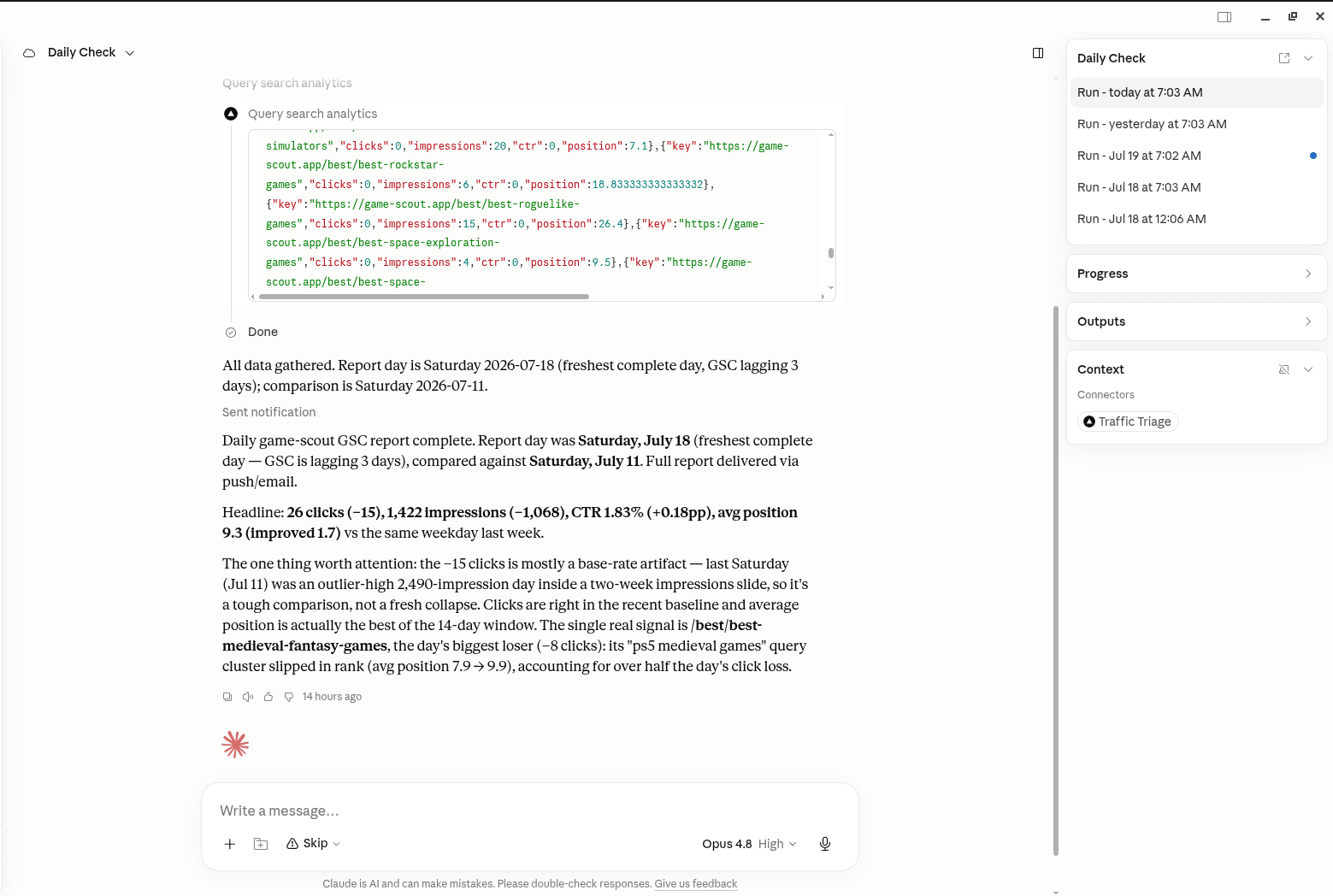
In your AI assistant
Ask your AI about your own site
TrafficTriage plugs into Claude, Cursor, and ChatGPT. Your assistant runs the 8 checks, reads your Search Console data, and can even check your site every morning. Free account, no API key, nothing to install.