
 TrafficTriage
AI Mode Follow-Up Queries in Search Console, Measured
By Ugur Saritepe · October 28, 2026
AI Mode follow-up queries in Search Console are the replies people type to Google's AI, logged as searches. On game-scout.app, 28 days to 2026-10-18, 1,015 of 7,227 query rows were follow-ups like "more" and "yes". They held 0.7% of impressions, at least a third were not in English, and they jumped on 2026-09-24.
Where this came from
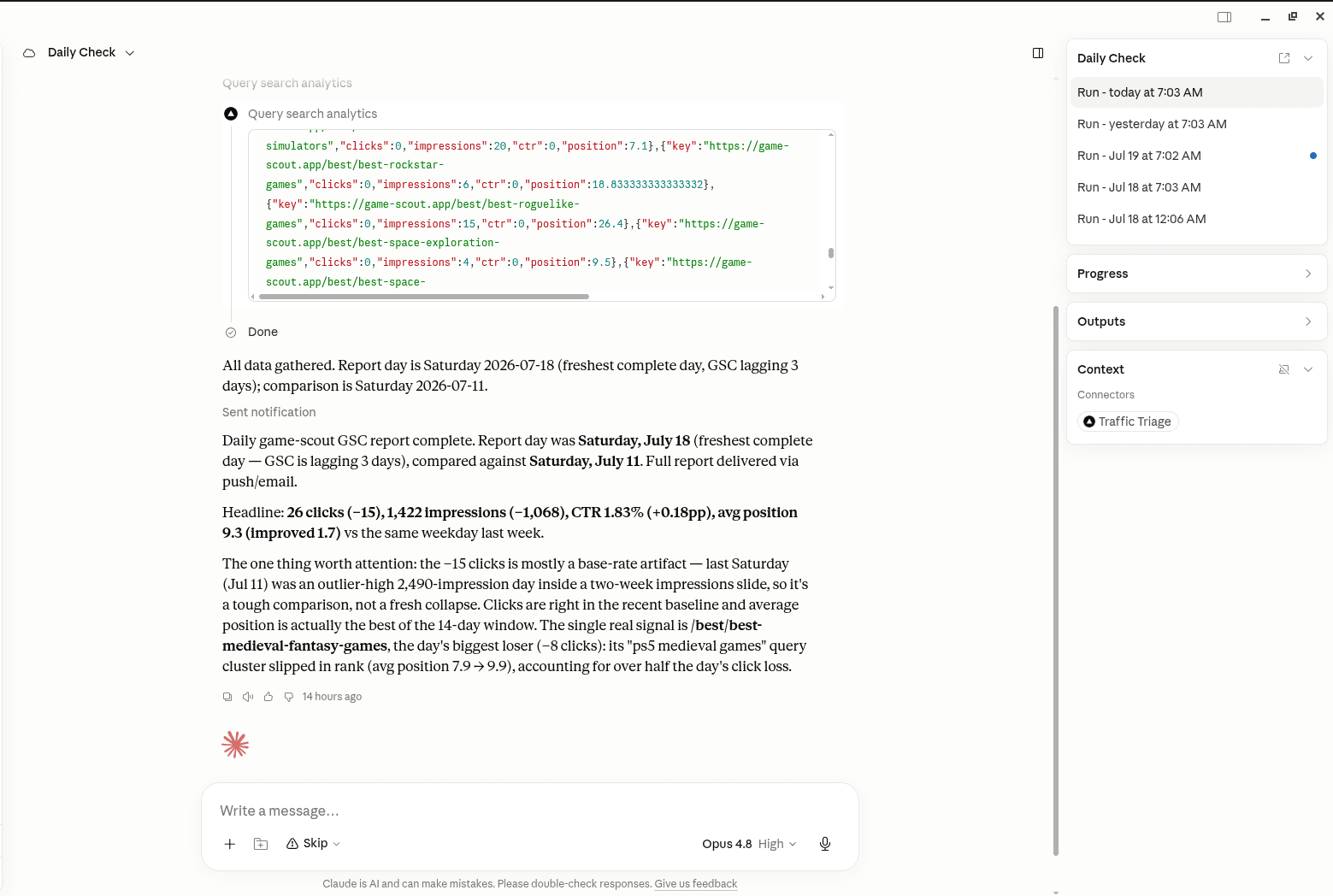
game-scout.app is my other site, a catalogue of curated PlayStation lists. On 2026-10-21 the assistant that runs this series for me pulled every query row on its six "games like" pages, to see whether that phrasing behaves like "best" does in titles. The rows came back with things in them nobody types into a search box:
sc-domain:game-scout.app, 2026-09-21 to 2026-10-18, query + page, page contains "games-like"
give me more             games-like-elden-ring        position 4
i played all of those    games-like-elden-ring        position 3
dame mas                 best-games-like-overcooked   position 5
rate them                best-games-like-overcooked   position 9
any more?                games-like-god-of-war        position 9
These are not searches. They are someone in a conversation with Google's AI Mode asking for more after an answer that already linked our list. The "games like" question was dropped and these were measured instead.
What Google says these rows are
Google counts every AI Mode follow-up as a new search query, with its own impressions, clicks and position. Search Console's help page on the Performance report says it in one line:
If a user asks a follow-up question within AI Mode, they are essentially performing a new query.
The same page says position in AI Mode follows the same method as a normal results page, and Google's AI features guide (updated 2025-12-10) says AI Mode is reported inside the Web search type. There is no AI Mode filter. So when someone types "yes" and the reply links your page, your Performance report gets a row for the query "yes", mixed in with everything people typed. Google does not label which rows these are. You have to find them by their shape.
How many there were on one site
To count them I needed every query row, not a sample, so I pulled all 7,227 query and page rows for the 28 days from Google's API. Then I called a row a follow-up when its query named nothing game-scout is about: no word from any of the site's URLs, no platform or genre, no number, and no "X vs Y". That rule is mine, and it is rough at the edges in both directions. Here is what it found:
game-scout.app, 2026-09-21 to 2026-10-18     rows   impressions   clicks   position
every query + page row                     7,227      52,009       835
follow-ups (query names nothing we cover)  1,015       1,110         8       6.7
every other row                            6,212      50,899       827      10.0
page report total (no query split)           438     152,501     2,506
Follow-ups were 14% of the rows and 12% of the distinct queries, but 0.7% of the site's impressions and 8 of its 2,506 clicks. 94.5% of them had a single impression. The most common were "more" (63 impressions across 34 pages) and "yes" (35 across 23), then "ja", "si" and "еще". A tighter version of the rule, which also requires a continuation word like "more", "other" or "which is better", still keeps 467 rows.
The ones that read like a transcript are the ones that convinced me: "i barely have any money", "kenn ich alles schon" (German for "I know all of these already"), "no inventes" and "ты сочиняешь?", both of which ask the AI whether it is making things up. Each of those carries a position, because Google treats it as a search our page ranked for.
They jumped on one day
From 2026-09-01 to 09-23 the site logged 0 to 7 follow-up impressions a day; from 09-24 it logged 18 to 73 on most days. The daily series, from a query and date pull of 43,142 rows:
follow-up impressions per day, game-scout.app
2026-09-01 to 09-23     0 to 7
2026-09-24             18
2026-09-25 to 10-04    31 to 71
2026-10-05 to 10-07     2 to 10
2026-10-08 to 10-18    36 to 73
The 28-day windows before agree: 9 follow-up rows to 2026-06-28, 11 to 07-26, 41 to 08-23, 43 to 09-20, then 1,015. Total impressions did not step on 09-24, so this is not the site suddenly getting more search traffic. I do not know what changed. Nothing in game-scout's git history for 09-22 to 09-24 touches anything AI-related, and the search I ran turned up no Google announcement dated that day. The three-day dip in early October is unexplained too. One analysis of another site dates its first rows to December 2025, so the date is this site's, not a launch date.
At least a third of them are not in English
330 of the 1,015 follow-up rows use letters plain English does not, and the English filters going around catch almost none of them. The two I found while reading the ranked pages:
filter                                        follow-up rows matched
^(yes|yeah|ok|okay|sure)[?!.,]*$                   34 of 1,015  (3%)
^(?:\S+\s+){9,}\S+$   (10 words or more)           0 of 1,015
That 330 is a floor: "ja", "si" and "mas" are not English either. The reply filter is too narrow for a site with readers in Germany, Turkey, Japan or the Arab world: "ja", "evet", "ほかに" and "نعم" all mean the same thing as "yes" or "anything else". The long-query filter finds a different thing entirely, long typed questions: 91% of follow-ups are three words or fewer and the longest is seven. Five of the 8 follow-up clicks came from rows in Romanian, Finnish, Arabic, Japanese and Chinese.
Where they land: list pages, not single pages
page type on game-scout.app     pages with impressions   with any follow-up row
curated lists (/best/)                   127                     94
articles and comparisons                  82                     38
single-game pages (/game/)               202                      1
AI Mode keeps linking list pages as the conversation goes on, and almost never a page about one game. That fits what the follow-ups ask for: more options, cheaper ones, free ones, which is best. Comparison articles get their own kind, "which is better" and "ratings?". On the PS Plus racing list, 77 of 161 query rows were follow-ups, nearly half.
That makes the follow-up rows a rough record of which of your pages AI Mode cites mid-conversation, which no report gives you by page. The limit is the sample: these are only the conversations where someone typed a reply that names nothing, and Search Console withholds rare queries, so the real count is higher.
What they change in your numbers
Your query export stops being a keyword list.One in seven rows on our site was a reply, not a search. Anyone sorting an export by query count, or saying a page "ranks for 161 keywords", is counting conversation fragments. This is the same lesson as query rows not adding up to the total, from the other side: there, rows were missing; here, rows are there that are not queries.
Average position gets slightly better than it should. The follow-ups sat at 6.7 against 10.0 for real queries. On the PS Plus racing list they moved the page's query-row position from 8.85 to 8.37. On 8 of the 12 pages with the most follow-up rows the change was under a tenth of a place, which is small next to the other ways average position misleads.
Totals barely move. 0.7% of impressions and 8 clicks in 28 days. If your clicks dropped, follow-ups are not the reason.
What we have not done
Our own tool caps a call at 250 rows, so an unfiltered pull on this site would never have shown me one of these rows: 94.5% of them have one impression and sort to the bottom. Filtered to a page, they show up, which is how I found them. We have not raised the cap. TrafficTriage does not tag follow-up rows either; the classification here was a script. And I have only one site big enough to see this: traffictriage.com returned 7 query rows in the same 28 days.
How to find them on your own site
- Pull query and page rows for one page, not the whole site. Pick a list or comparison page with a few hundred impressions a week. Good: you get every row for that page. Bad: a site-wide top-25 or top-250, where one-impression rows never appear.
- Mark every query that names nothing the page is about. No product, topic, brand or number from your site. "more", "yes", "which is better", "any free ones" and their translations are the common shapes.
- Add them up against the page's total.Good: they are a few percent of impressions, and you now know AI Mode cites the page. Bad: you were about to write content for "more".
- Pull the same page by date. If the rows begin on one day, as ours did on 2026-09-24, that is when AI Mode started linking the page in conversations, and it is worth writing down.
Doing this by hand across a site is a long afternoon; it is the kind of pass that works well when an assistant groups the queries for you. If a page you expected AI Mode to cite has no follow-up rows at all, the free triage report checks from the outside whether it is crawlable and indexable. The rest of these measured reads are in the AI-assistant SEO series.
FAQ
Why does Search Console show "yes" or "more" as a query?
Because someone typed it into Google AI Mode as a follow-up, and Google counts a follow-up as a new query. If your page was linked in the answer to that follow-up, Search Console records an impression for your page against the word "yes". On game-scout.app, 28 days to 2026-10-18, "more" drew 63 impressions on 34 pages and "yes" 35 on 23.
Can I filter AI Mode traffic out of Search Console?
Not directly. Google reports AI Mode inside the Web search type with no separate label, so there is no filter for it. You can find the follow-up rows by their shape: short queries that name nothing your site is about. On our site those were 14% of query rows and 0.7% of impressions, so removing them changes your query list far more than your totals.
Do AI Mode follow-up queries hurt my average position?
They tend to flatter it slightly. On game-scout.app the follow-up rows sat at an impression-weighted position of 6.7 against 10.0 for every other row. On the page where they were densest, 77 of 161 query rows, they moved the page's position from 8.85 to 8.37. On 8 of the 12 pages with the most follow-up rows the effect was under a tenth of a place.
Does a regex for long queries find AI Mode queries?
It finds long, typed questions, not follow-ups. 91% of the follow-up rows on our site were three words or fewer, so a ten-word regex matches none of them. An English reply regex for yes, ok and sure matched 3% of them, because at least a third of the rows were in other languages.
One page's follow-up rows are one tool call. Connect Search Console to the TrafficTriage MCP server and ask your assistant for a page's query rows over 28 days, then ask which ones name nothing the page covers. Each call returns up to 250 rows with exact totals, enough for one page, and the sorting into replies and searches happens in the conversation, in any language.
In your AI assistant
Ask your AI about your own site
TrafficTriage plugs into Claude, Cursor, and ChatGPT. Your assistant runs the 8 checks, reads your Search Console data, and can even check your site every morning. Free account, no API key, nothing to install.