
 TrafficTriage
Search Console Impressions but No Clicks: Read the Queries
By Ugur Saritepe · September 5, 2026
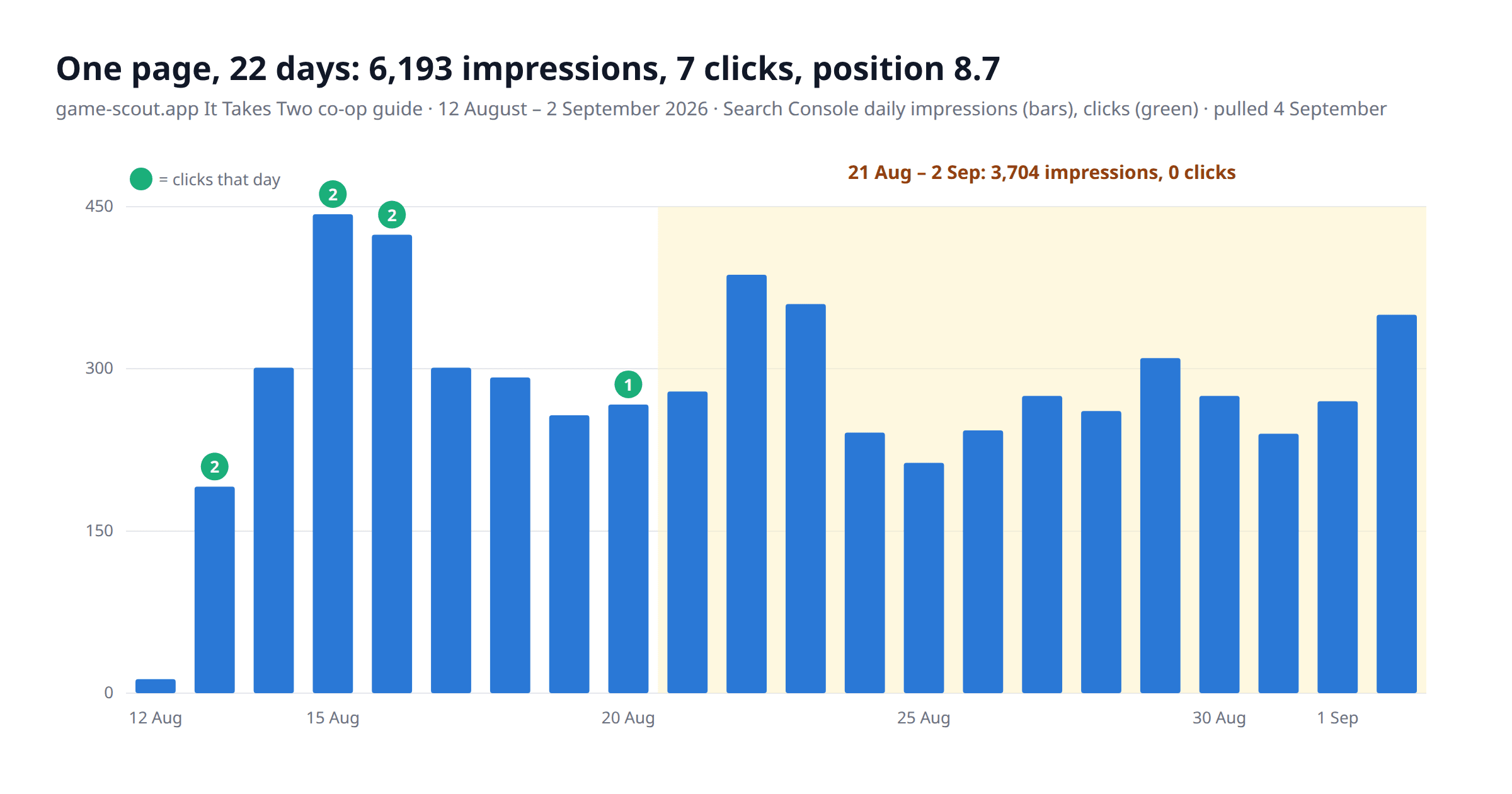
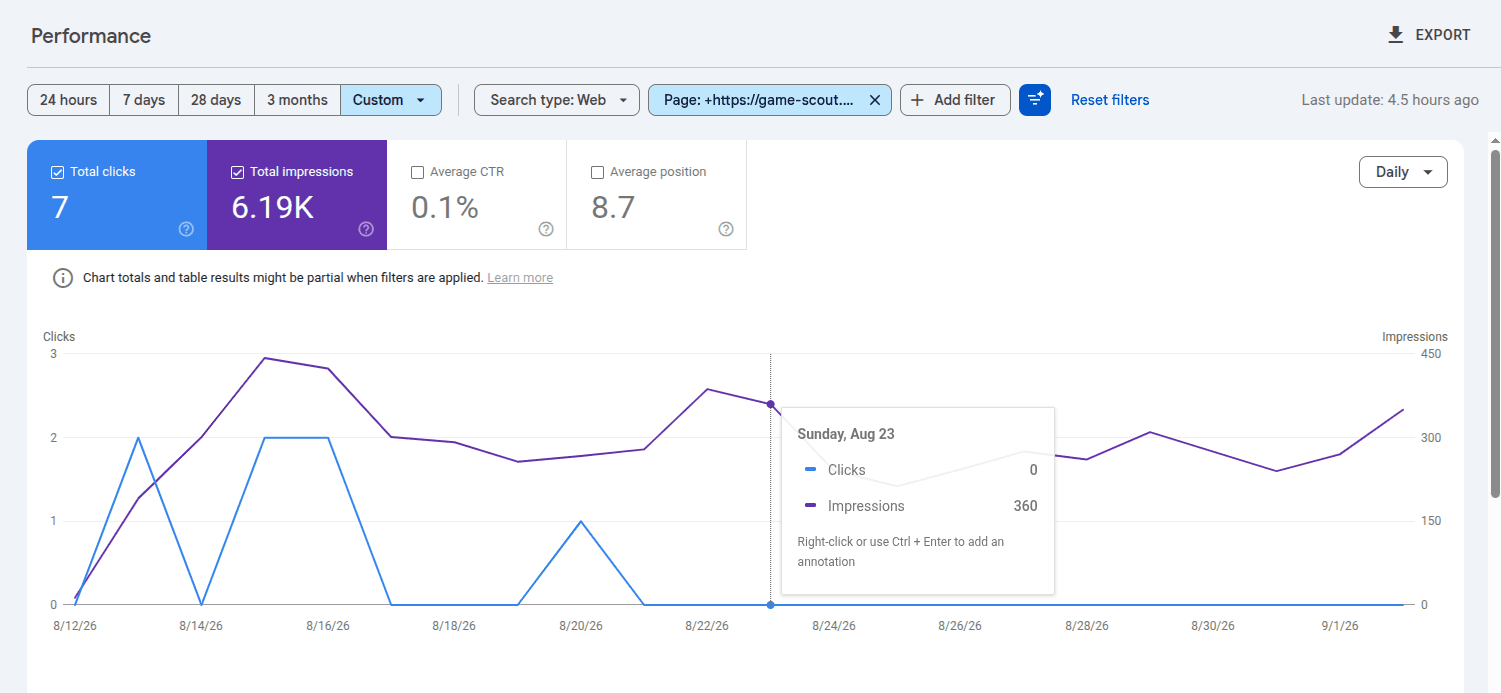
A page on my games site sits at position 8.7 on Google, earned 6,193 impressions in its first 22 days, and got 7 clicks. Thirteen of those days had zero clicks against 3,704 impressions. The page is not broken and the title is not wrong. The 200 queries it ranks for explain it, and reading them took one session with Search Console connected to an assistant.
An impression is not a person who saw your link
Search Console counts an impression, in Google's own definition, whenever your result appears in the current page of results, whether or not it was scrolled into view. Position 8.7 on a phone is page one, but it is below at least seven other results and a People Also Ask box. Some share of the 6,193 people in that number never scrolled as far as my link, and Google counted them anyway. That is the first thing to hold onto when a page shows thousands of impressions and a handful of clicks: the gap is partly how impressions are counted, and a title change cannot touch that part.
The page in question is a co-op guide for It Takes Two, published on 12 August. Its daily position stayed between 8.4 and 10.2 for the whole 22 days, so nothing moved in the rankings. What moved was nothing: the clicks stopped on 20 August and never came back while impressions ran between 213 and 387 a day.
What the 200 queries said
The Search Console interface shows a page's queries one screen at a time. With the property connected to an assistant, the whole list is one ask:
Pull every query this page ranks for, with impressions, clicks and position.
page     https://game-scout.app/articles/game-tips/it-takes-two/co-op-guide
dims     query      rowLimit 250
is it takes two split screen              478   0 clicks   pos 9.0
it takes two split screen                 353   1          8.1
can you play it takes two split screen    264   0          9.0
is it takes 2 split screen                 79   0          9.3
does it takes two have split screen        62   0          8.7
200 rows, not truncated · rows sum to 2,567 impr / 2 clicks · page 6,193 / 7
184 of the 200 disclosed queries ask how two people get into the game: on one screen, one console, one copy, or online. 82 of them start with "is", "can", "does", "do" or "how many". The page answers every one of them with one word, and so does the results page.
Grouped by what the searcher wanted to know, the disclosed queries break down like this:
what the query asks                          queries   impressions   clicks
"split screen" in any spelling                    65         1,817        1
same console / local / couch / offline            53           403        1
online / Friend's Pass / one copy / both players  46           242        0
solo / player count / cross-play                  20            80        0
everything else                                   16            25        0
One honesty note before the diagnosis. The 200 rows carry 2,567 of the page's 6,193 impressions and 2 of its 7 clicks; the rest sit in queries Google does not disclose. Everything I say about "the queries" is about the 41% Google shows me. I have no reason to think the hidden 59% ask something different, and no way to check.
Three reasons a page gets impressions but no clicks
Each has a check that takes under a minute, and each is either ruled in or out by what my own page showed.
reason                          check                                    my page
1 ranks below what people read  position column; compare a sibling       8.7; sibling at 9.0 gets 0.29%,
                                page at a similar position               sibling at 6.6 gets 4.67%
2 title/description miss the    search the top query, read your own      "Split-Screen" is in the title,
  query                         snippet next to the others               third; description says it too
3 the results page answers      search the top query in a private        People Also Ask box with four
  the question first            window; note what sits above you         versions of it, store snippets
                                                                         stating the answer
Reason 1 is real and not sufficient.Two other guides in the same section, over the same 28 days, sat within three positions of this page: the Asphalt best-cars list at position 6.6 with 1,927 impressions and 90 clicks (4.67%), and the Baldur's Gate 3 co-op guide at 9.0 with 1,369 impressions and 4 clicks (0.29%). A two-position gap does not explain a forty-times gap in click rate. What the Asphalt page ranks for is "best cars", which needs a page to answer. What the two co-op guides rank for needs one word.
Reason 2 is what I checked first and it came back clean. The title is "It Takes Two Co-Op: Split-Screen, Online, Friend's Pass" and the description opens with "two-player split-screen". A title-length check passes it, and so does the page-basics check in the free report, which reads the page from its URL and cannot see a single query. A page can pass every on-page check and still earn nothing, because the check that mattered here lives in the query list, not the HTML.
Reason 3 is the one the queries point at.On 4 September I pulled the mobile results for the top query, "is it takes two split screen". There is no featured snippet. There is a People Also Ask box with four versions of the question, two Reddit threads, a Steam forum thread, an EA forum thread, Wikipedia, the Steam store page and EA's feature page, in that order, and the Steam and EA snippets both state that the game offers couch or online co-op with split-screen play. My page is not among those seven. Someone typing that query has the question asked back at them four times in the People Also Ask box and answered in three snippets before they can scroll to me, and the 478 impressions that query gave me in 28 days produced 0 clicks.
My theory was that the article was not good enough
I did not arrive at reason 3 on my own. A week after the page went live, I read the impression count, decided the article must be weak, and asked for something bigger:
We have a lot of impressions from It Takes Two but I think our article might be not good enough, can you check this. This might be a good opportunity to convert to a cluster instead. It Takes Two has a lot of hard sections and people always search for it. We can maybe put different guides and connect them together. Check this if it can be a cluster.
The answer, four minutes later, went the other way on both counts. The page was six days old, already at position 8.9, and pulling about 350 impressions a day, the fastest ramp of any guide on the site. The assistant read the article and called it good. Then it pulled the 124 queries the page ranked for at the time and found the same thing the 200 show above: one question, paraphrased. The problem was not the article; it was which question the article was being shown for.
The walkthrough cluster fared worse. For "it takes two walkthrough", five of the top ten results were YouTube videos, with IGN's wiki and Neoseeker behind them. My catalogue holds modes, player counts, playtime and ratings, and nothing about boss strategy or minigame locations, so every guide in that cluster would have been invented against the strongest specialists on the web. The assistant also said what it could not measure: its demand tool returned the same 486,000 for every It Takes Two phrase it tried, a topic bucket rather than a number, so it judged on the shape of the results page and on what my data could ground, not on volume. The cluster was never built. The site's git history shows no It Takes Two page after 12 August.
What the assistant recommended instead was the cheap thing: lead the title with the question and its answer, an hour's work, and see what the click rate does before building anything. At the impression rate the page had then, moving from 0.36% to 2% was worth about 170 clicks a month, more than any new page would have earned. That recommendation is where the next section starts.
Seventeen comparison articles, same shape
This is not one unlucky page. In the 28 days to 3 September, the site's 17 "X vs Y" comparison articles earned 3,944 impressions and 18 clicks between them, a 0.46% click rate at an average position of 10.0; eight of the 17 got no click at all. The twelve other guides in the tips section, the It Takes Two page excluded, ran at 1.52%. Back on 6 August, when the same class was 12 pages with 1,102 impressions and 2 clicks, the explanation I recorded was that the results page answers "X vs Y" inline and leaves the page on the second screen. The 4 September numbers are wider, not different: a query the results page can settle without a click is a query that pays in impressions.
For scale, not proof: some of those 17 pages spent August not indexed at all, which drags the class average down for reasons that have nothing to do with intent. The pattern holds on the older pages alone, and I would rather say the read is contaminated than pretend it is clean.
The title I decided not to change
As of 5 September the title is unchanged, and it is staying that way. The 19 August recommendation was to lead with the question and its answer instead of the game's name and a colon. Google's title-link guidance asks for descriptive and concise text and notes that Google may rewrite a title link it judges not to reflect the page, and both cut against expecting much from the edit. But the reason I am leaving it is not the size of the lift. It is what the page is for:
For this page there is no need to change the title, because we already had the answer in the intro and the FAQ, and the article is more like a guide that I can share with the game itself. My point is not proving the question it gets the answer for; I am trying to create a support layer for the games I show. Even if I give the answer in the title, people would not click, and even if they click it does not mean anything, because it is just a guide page, not their answer.
The guide is not a landing page. It exists so that someone who found It Takes Two on my site has one place that settles the setup questions: solo or not, how many players, one copy or two, cross-play. It is linked by hand from the game's entry in the local co-op list, and since 31 August every list that includes the game links to it from the game's own card, by rule. The intro says "co-op only" in its first sentence and the second FAQ answers the split-screen question with "Yes". A searcher who wanted that word already got it on the results page. If a new title pulled 170 of them a month onto the page, they would read one word and leave, and the click would say nothing about whether the guide does its job.
This is the part of "impressions but no clicks" that the checklists skip. The three checks above tell you why the clicks are missing. They do not tell you whether you want them. A page written to support your own catalogue can rank for a yes/no question, earn nothing from it, and still be the right page. Its measure is whether the people who reach it from inside the site get their game set up, and Search Console cannot see that. No prediction is logged, because there is no change to grade, and the decision is mine rather than the assistant's, which recommended the rewrite.
One more fact for the record, because it would apply to anyone who does change a title after reading this:
When did Google last fetch the It Takes Two guide?
url https://game-scout.app/articles/game-tips/it-takes-two/co-op-guide
coverageState     Submitted and indexed     verdict PASS
lastCrawlTime     2026-08-12T19:47:53Z
referringUrlCount 0
richResultTypes   Breadcrumbs, Review snippets, Videos
Fetched once, on the day it was published, and not since. A new title cannot reach the results page until the next fetch, and nothing on the site has prompted one in 23 days.
So if you do rewrite a title, the sequence is: change it, watch for the next crawl date in URL Inspection, and only then start the clock on the prediction. A title edit judged on the week after the edit, rather than the weeks after the crawl, will look like it did nothing whether or not it worked.
Pull your own queries in one session
Search Console shows you the impressions and the clicks. It does not tell you which of the three reasons you have, and the one that matters most is the hardest to see from the interface, because it lives in the results page rather than in your report. With Search Console connected to an assistant, it is three asks.
1."Which of my pages had the most impressions and the fewest clicks in the last 28 days?" Start with the page where the gap is widest, not the one you care about most. 2."List every query for that page with its position, and group them by what the searcher wants to know." Read the first word of each. A list of "best", "how to" and "which" queries wants a page; a list of "is", "can" and "does" queries wants a word. 3."Search the top query and tell me what sits above my result." A People Also Ask box or a featured snippet that answers it is your answer too. Then decide: rewrite the title on the pages whose queries need a page, log the date and the expected clicks, and leave the rest alone. The numbers in this post came from exactly that loop, inside the morning routine I already run on both my sites, and they belong in the symptom guides because the symptom is common and the diagnosis is not.
FAQ
Why does my page get impressions but no clicks in Search Console?
Three reasons cover almost every case: the page ranks on page one but below what people read, the title and description do not match what the query wants, or the query is a question the results page already answers above your link. Pull the page's query list to tell them apart. If most queries start with is, can, does or do, and the results page carries a People Also Ask box or store listings that answer them, no title will buy many clicks.
Is a low click-through rate at position 8 to 10 normal?
Position alone does not set it. On my site, three pages within three positions of each other had click-through rates of 4.67% at position 6.6, 0.29% at 9.0 and 0.11% at 8.7 over the same 28 days. The difference was what sat above each result: a list people had to open, against yes/no questions answered on the results page. Compare your page to a sibling at a similar position before blaming the position.
Will rewriting the title fix impressions without clicks?
Only when the query needs a page to answer it, and only when the click would mean something. A title rewrite costs an hour and is worth trying on a page built to be found from search; Google has to fetch the page again before a new title can appear, and it may rewrite the title link anyway. On a guide that exists to support other pages on your site, a click from a yes/no searcher is a bounce. I left mine unchanged and the post says why.
Read your own query list the same way. Create a free account, connect Search Console, and your assistant can pull every query for any page, check what the results page shows above you, and log the prediction before you touch a title. Every tool is read-only against Google. The MCP server works with Claude, Cursor, or anything else that speaks the protocol.
In your AI assistant
Ask your AI about your own site
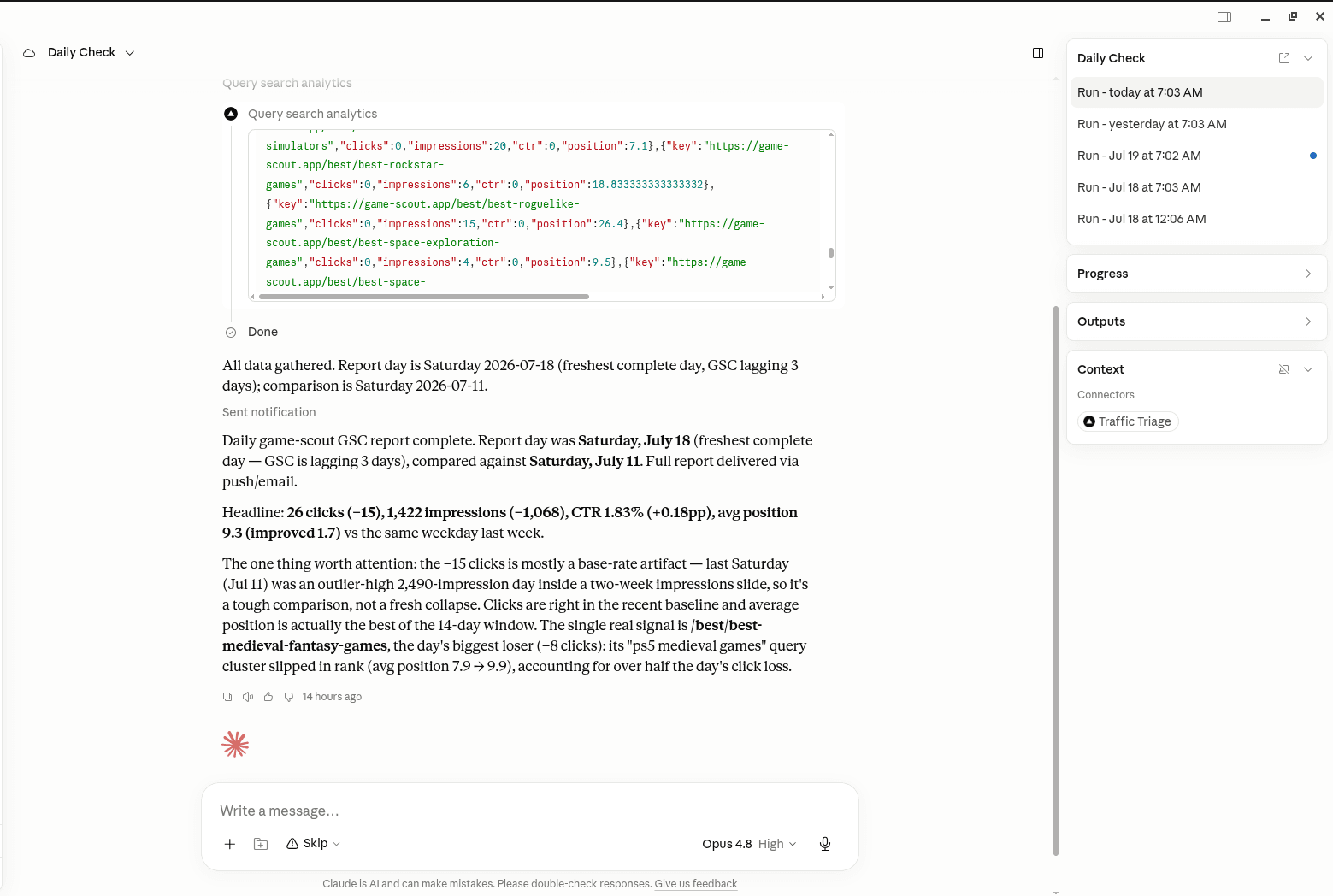
TrafficTriage plugs into Claude, Cursor, and ChatGPT. Your assistant runs the 8 checks, reads your Search Console data, and can even check your site every morning. Free account, no API key, nothing to install.