
 TrafficTriage
Does Changing Title Tags Improve Rankings? 6 Pages
By Ugur Saritepe · October 28, 2026
Does changing title tags improve rankings? I rewrote six page titles on my own site on one day, projected the result in advance as a number, and read it back on the date I had written down. Click-through rate moved a little. Rankings did not. The batch was beaten by the pages I left alone.
The bet, written as arithmetic
game-scout.app is the games directory I run and write about openly. On 28 August 2026 I sat down to work out where a few hours would buy the most clicks:
Lets think about our app. You are the seo engineer. Right now I am trying to improve our clicks so we can earn more from ads. More engagement in the site so ads will pay more.
The answer was a title batch on the six low-CTR list pages that were not sitting inside some other measurement window. What makes this worth writing up is that the projection was written as arithmetic before anything changed: each page's impressions multiplied by the click-through rate I expected it to reach.
4,111 x (3.5 - 1.48)%   police
3,930 x (3.5 - 1.98)%   animal
3,242 x (3.0 - 1.70)%   medieval-fantasy
1,874 x (3.0 - 1.23)%   hunting
1,184 x (3.0 - 0.68)%   pirate
1,354 x (3.5 - 1.99)%   house-design
                        = +265 clicks/mo
Two things in that block matter more than the total. The first is that every page needed to land somewhere between 3.0% and 3.5% click-through rate for the number to come true, roughly double where each one sat. The second is the sentence written next to it: re-check around 18 September on a clean 14-day window. The grading date was part of the bet. Today is 18 September, so this is the grading.
What actually changed on the six pages
Commit ede5ddflanded at 17:55 on 28 August, five minutes after I typed "We can start working on list pages with proposal changes." Six files, three fields each. Here are three of the six:
- Best Animal Games on PS5 & PS4 (2026): Play as an Animal
+ Best Animal Games on PS5 & PS4 (2026): Stray, Goose Game & More

- Best Police Games for PS5 & PS4 (2026) - Cop & Police Sim Games
+ Best Police Games on PS5 & PS4 (2026): Police Simulator & More

- Best Hunting Games for PS5 & PS4 (2026) - Ranked
+ Best Hunting Games on PS5 & PS4 (2026): theHunter & Way of the Hunter
The pattern was to name the actual games instead of describing the category. Note what else moved in the same commit: the H1 and the meta description changed on every page too. This grades a title block, not a title. Two of the six also lost a "- Ranked" suffix here, a scaffolded habit I had already started to doubt and dropped from the template a week later:
I dont think it make any sense to have ranked at the end.
The readout on the date the bet named
The window is the one the bet asked for: 4 to 17 September against 14 to 27 August, both 14 days, with a week either side of the change for recrawling. Every page had picked up its new title well inside that.
page                    clicks      impressions      CTR
police                  30 -> 51    2,172 -> 2,914   1.38 -> 1.75%
hunting                 12 -> 24    1,432 -> 1,875   0.84 -> 1.28%
animal                  33 -> 40    2,061 -> 2,108   1.60 -> 1.90%
medieval-fantasy        35 -> 25    1,652 -> 1,719   2.12 -> 1.45%
house-design            18 -> 16      777 ->   807   2.32 -> 1.98%
pirate                   6 ->  5      969 ->   430   0.62 -> 1.16%
TOTAL                  134 -> 161   9,063 -> 9,853   1.48 -> 1.63%
Twenty-seven extra clicks in fourteen days is about 58 a month against a projected 265. Three pages up, three down. Not one of the six reached the 3.0% to 3.5% the arithmetic needed; the best of them, police, got to 1.75%.
The 82 pages I did not touch
A 20% click gain reads like a modest win right up to the moment you ask what the rest of the site did. game-scout.app has 82 other /best/ list pages that nobody edited in this window, which makes a serviceable control group: same site, same template, same fortnight, same everything except the change.
cohort                   n     clicks            impressions        CTR
the six retitled         6     134 -> 161 (+20%)  9,063 ->  9,853 (+9%)   1.48 -> 1.63%
untouched /best/ lists  82     797 -> 1,131 (+42%) 31,933 -> 47,262 (+48%) 2.50 -> 2.39%
whole property           -   1,052 -> 1,409 (+34%) 53,267 -> 70,578 (+33%) 1.98 -> 2.00%
The pages I left alone grew their clicks twice as fast as the pages I worked on. Against its own past the batch looks like a success; against the site it lives on it lost ground. This is the single most useful thing in the whole exercise and it costs one extra row in a spreadsheet.
There is one place the six genuinely beat the control, and it is the place the theory predicts: their click-through rate rose from 1.48% to 1.63% while the control's fell from 2.50% to 2.39% and the property overall held flat near 1.98%. A title change is supposed to move the rate at which people click a result they were already being shown. That is what happened. It just was not worth 265 clicks a month.
Two honest problems with that reading, both of which push the same way. The six were picked becausethey had low click-through rates, so some of the rise is regression to the mean rather than anything I wrote. And the control grew its impressions 48% against the six's 9%, which is a difference in topic and demand before it is anything about titles. The CTR comparison survives that; the clicks comparison does not, which is why I am not claiming the batch caused the shortfall.
What the query rows show
Page totals hide the mechanism. Pulling the queries for each page and comparing the same two windows turns one blurred result into three clearly different ones.
Police: the named entity won its own query.The new title says "Police Simulator". The query "best police simulator games ps5" went from 1 click to 6, from 20 impressions to 33, and from position 6.90 to 3.76. That is the biggest single movement anywhere in the batch, and it is on the exact words added to the title. Meanwhile the generic family the page already owned gave ground: "police games ps5" 6 clicks to 4, "best police games ps5" 3 to 1.
Hunting: the entity never showed up at all.The new title names theHunter and Way of the Hunter. Neither appears in a single query row. The page's gain is entirely on a query it already ranked for, at a position that did not move:
"best hunting game ps5"    before            after
clicks                     3                 7
impressions                162               158
position                   7.877             7.861
CTR                        1.85%             4.43%
Same slot on the results page, same number of people seeing it, more than double the share of them clicking. That is the title-link lever in its purest form, and it happens to be one of the two pages that also lost the "- Ranked" suffix, so I cannot tell you which half of the edit did it.
Medieval-fantasy: the new family arrived and did not pay for the old one. Adding the word "Fantasy" did exactly what it was meant to: "medieval fantasy games ps5" appeared from nothing at 2 clicks and 14 impressions, with three more fantasy variants showing up at positions 22 to 25. The page still lost 10 clicks net, spread across a long tail of "medieval games ps4"-shaped queries that each held one click before and none after.
One caveat on all three: query rows are thinned by Google's anonymisation, not just by the row limit I asked for. The police page holds 2,914 impressions in this window and the 16 rows I got back account for about 450 of them. A query missing from those rows is not visible; it is not zero.
What Google says a title actually does
Worth reading the source before arguing about ranking factors. Google's title link documentation (last updated 10 December 2025) lists nine things it may use to build the clickable title in a result: the <title> element, the main visual title on the page, headings such as <h1>, og:title, other large and prominent styled text, other text on the page, anchor text on the page, text in links pointing at the page, and WebSite structured data.
Your title element is one of nine inputs to one part of one result. That page never describes the title element as a ranking factor. It is documentation about appearance, and the five conditions it gives for Google replacing your title, half-empty titles, obsolete content, inaccurate descriptions, boilerplate repeated across pages, and a language mismatch, are all about whether the result reads well. That matches what I measured: a rate change, not a position change.
What I would do differently
- Write the control group down before the change. I got one by accident because 82 pages happened to sit still. Naming them in advance costs nothing and is the only reason this readout means anything.
- Change one field. Title, H1 and meta description all moved in the same commit on all six pages, and two of them also lost a suffix. Six pages was already a small sample; four variables on top of that means the batch can tell me it worked and never tell me why.
- Read the query families first.Police had a real "police simulator" family to go and win. Hunting's named games had no query volume behind them at all, which a query pull would have shown for free before I wrote the title.
- Project a range, not a number."+265 clicks a month" was every page doubling its click-through rate at once. Nothing in the record justified the top of that range as the expectation.
There is also a recommendation I was given and have not acted on. The session that worked out why an earlier title change had succeeded told me to rank pages by CTR residual, the gap between the click-through rate a page gets and the one its position predicts, rather than by raw CTR, so that a page which ranks well can be told apart from one that converts well. We have not built it. The six pages in this batch were picked on raw click-through rate, which is the metric that advice specifically said was the wrong one to pick on.
One page in the set stays unexplained. best-pirate-games lost 56% of its impressions and fell from position 8.6 to 11.0 in this window, which no title edit accounts for, and it drags the group total down with it. I have not worked out what happened there and I am not going to pretend the title did it.
Running this on your own pages
The whole measurement is four Search Console pulls, and the only awkward part is remembering to take the "before" one.
- Before you edit: pull the page's queries and note which families carry the impressions. This is the step that tells you whether the words you are about to add have anyone searching for them.
- Write down the change date, the re-check date, and the pages you are not touching.
- After the wait: pull the same two windows for the edited pages and for the control set, and compare the change to the change, never the page to its own past.
- Then pull queries again on the edited pages. Page totals tell you whether something happened; query rows tell you what.
If a page of yours is not getting clicked at all and you are not sure the title is even the problem, the free triage report reads the title, H1 and meta description a crawler actually receives from a URL in about 30 seconds. More of the AI-assistant SEO series works through my own numbers this way, including what average position hides when you split a page by query and what to check when the impressions are there and the clicks are not. The length side of this question lives in the 60-character limit.
FAQ
Does changing title tags improve rankings?
On my own site it moved click-through rate and did not move rankings. Six pages on game-scout.app were retitled on 28 August 2026. Fourteen days later their average position had moved by less than a place in either direction, but their click-through rate went from 1.48% to 1.63% while 82 untouched pages on the same site fell from 2.50% to 2.39%. Google's own title-link documentation does not describe the title element as a ranking factor.
How long does it take for a title change to show up in search?
Long enough that you need a gap on both sides of the change. I gave mine a week to be recrawled and then read a clean 14-day window, 4 to 17 September, against the 14 days ending the day before the change. All six pages had picked up the new title well inside that. The measurement problem is not the wait, it is that your site keeps moving while you wait.
Why did my clicks go up after a title change but not as much as expected?
Compare the page against the rest of your site, not against itself. My six retitled pages gained 20% more clicks, which looks like a win until you see that 82 pages nobody touched gained 42% over the same fortnight. Judged against its own past the batch worked. Judged against the site it lives on, it lost ground.
Should I put specific product names in my title tag?
It wins that product's query and can cost you on the generic one. Adding 'Police Simulator' to a title took that exact query from 1 click to 6 and from position 6.9 to 3.8, while the page's plain 'police games ps5' family lost clicks. On another page the two product names added never appeared in a single query row, and the gain came from the query it already ranked for converting better.
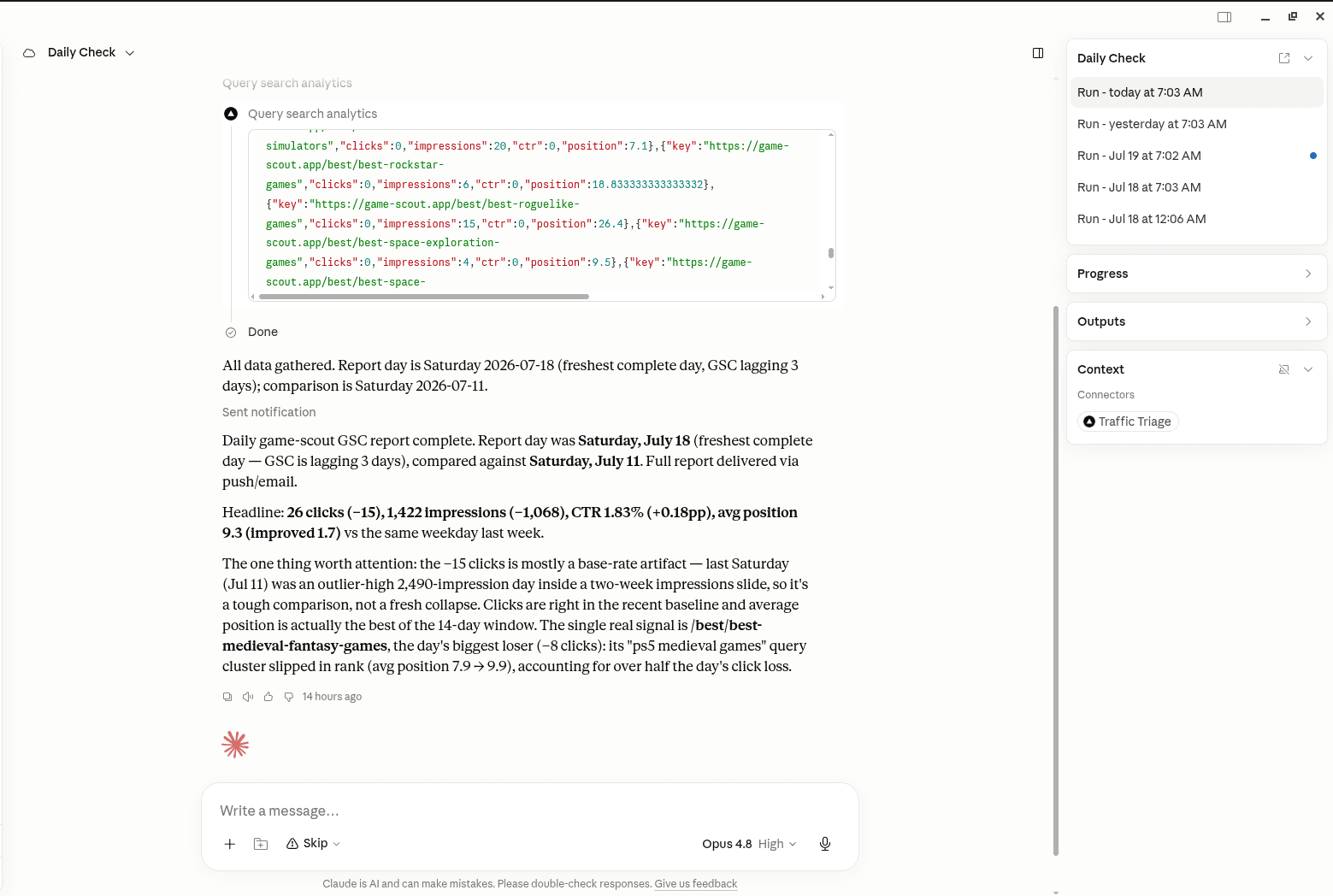
You cannot grade a title change against the page's own past. Create a free account, connect Search Console, and the MCP server lets your assistant pull the query rows for any page across two windows and compare them, which is every number in this post. Ask it for the queries a page earns before you rewrite the title, and again after, and for the same two windows on the pages you left alone.
In your AI assistant
Ask your AI about your own site
TrafficTriage plugs into Claude, Cursor, and ChatGPT. Your assistant runs the 8 checks, reads your Search Console data, and can even check your site every morning. Free account, no API key, nothing to install.