
 TrafficTriage
Two Pages Ranking for the Same Keyword: Google Picked One
By Ugur Saritepe · September 5, 2026
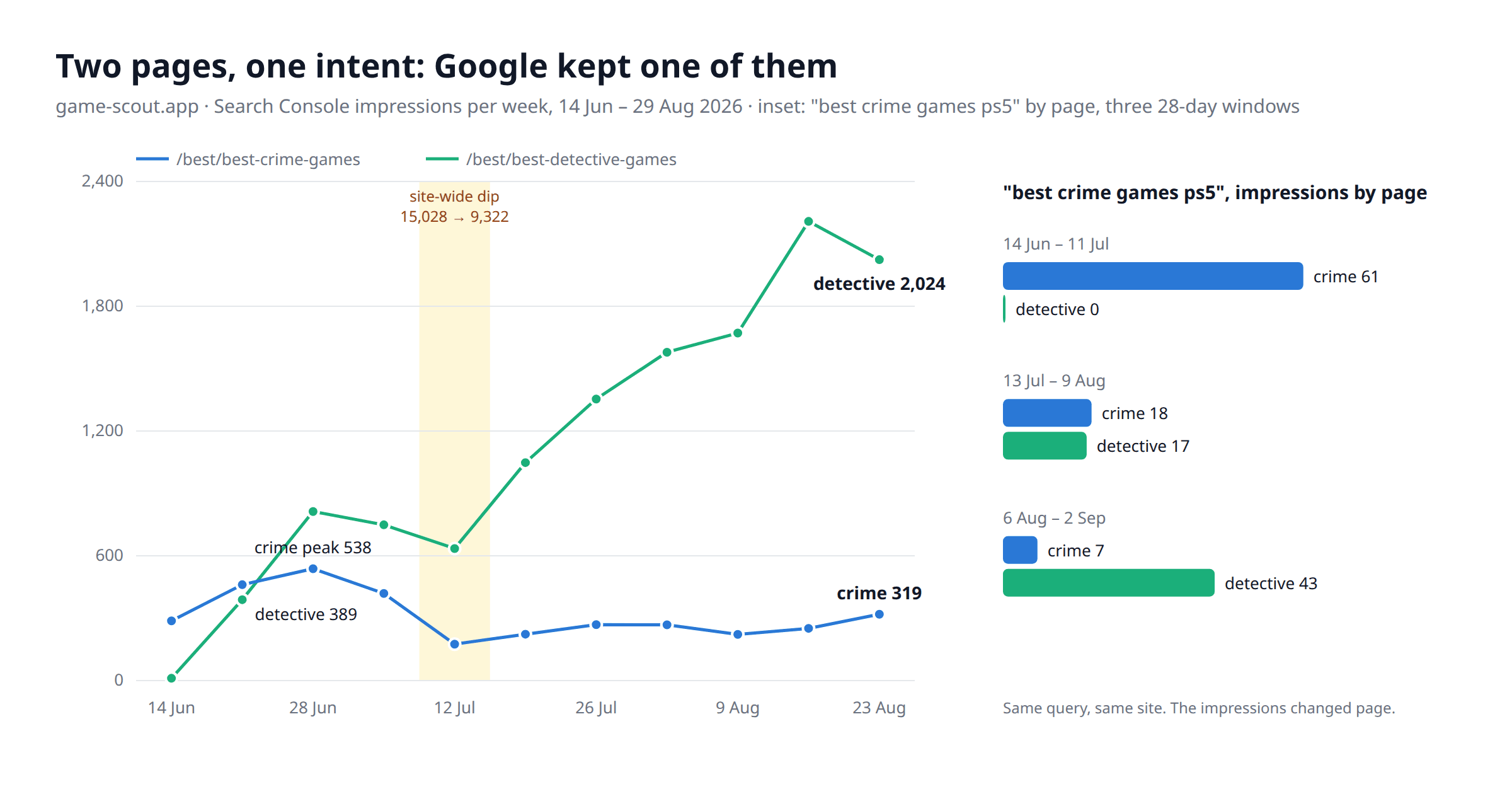
On 30 August I asked why the crime games list on my games site had gone quiet. Nothing on the page had broken. Google had folded crime, detective and mystery into one intent and kept my detective page for all of it: the head query went from 61 impressions on the crime page alone to 43 on detective and 7 on crime. It was the third time in three months that two of my own pages had competed for one query, and the right move was different every time.
Search Console will not tell you which page won
Search Console's position number is, in Google's own definition, the topmost position any link to your site held for that search, averaged over the impressions. When you look at a query, you get one position line for the whole site, whichever of your pages Google showed. Two pages taking turns on one query look like one page holding steady. The Queries tab and the Pages tab each hide the other half.
The check is the one pull the interface makes awkward: the query as a filter, the page as the dimension. One row is the healthy answer. Two rows means Google is choosing between your pages, and the row with the better position is its choice. Here is what it returned for the crime query, in three 28-day windows:
For "best crime games ps5", which of my pages did Google show, by 28-day window?
site     sc-domain:game-scout.app
dims     page      filter  query equals "best crime games ps5"
14 Jun – 11 Jul   /best/best-crime-games       61 impr   5 clicks   pos 4.4
13 Jul –  9 Aug   /best/best-crime-games       18         1          7.5
                  /best/best-detective-games   17         1          6.1
 6 Aug –  2 Sep   /best/best-detective-games   43         4          5.8
/best/best-crime-games 7 0 6.3One page, then two, then the other page. The site's position on this query barely moved. The page that receives the click changed completely.
Everything below is that pull, run on four pairs of pages, with what each one turned out to mean. The pages are all on game-scout.app, a PlayStation games site I run and use as the test bed for this one.
Case 1: two intents became one, and the stronger page kept it
What I typed on 30 August:
Lets check our best-crime-games, this page was working really well first then it start go down no it seems more stable but I am trying to understand if we change anything that cause the downgrade or google was just trying out. It seems to be linked super good pages we have like detective games. So what is wrong with this page? Is bounce rate high? Do we lose because of the games we selected? Do we lose because intro we changed? Should we do something closer to detective games? Lets compare against detective games and other competitors in same target query with serp
Five hypotheses, and the data ruled out four of them before it said anything else. The slide ran from 5 July to 11 July: crime went from 89 impressions a day to 32, and detective fell alongside it, from 172 to 60, while the whole site dropped from 15,028 impressions to 9,322 that week. The intro rewrite I suspected shipped on 12 July, a day after the low point, so it could not have caused it. The comparison table went onto both pages, and detective rose. Engagement in Analytics was 73.1% on the crime page, the highest of the four lists we compared, so nobody was bouncing. And the crime page never fell further: it has sat between 222 and 319 impressions a week for eight weeks while the site around it grew.
What did happen is in the table above. Across every query containing "crime" in the 28 days to 2 September, the detective page earned 190 impressions and 13 clicks; the crime page earned 93 and 3. The detective page ranks for 116 different queries, the crime page for 33. When Google has two of your pages that fit one intent, it keeps the one with more reach, and the results page explained why these two fit one intent. Of the eight results for "best crime games ps5" when we checked on 30 August, five were forum threads, and two of those were people asking for detective and murder-mystery games. On "detective games ps5", four of the top six were editorial lists like ours. Google treats the three words as one question on PlayStation, and it answers with the page that covers most of it.
The detective page did gain "& Mystery" in its title on 12 July. I list it as a date on the timeline, not as the cause: the slide began a week before it, and the crime queries kept migrating for weeks after. What I have not done is decide. The crime page still holds queries of its own that detective does not touch, "heist games ps5" at 52 impressions and "best gangster games ps5" at 23 in the same 28 days, both served only by the crime page. Narrowing it to those and letting detective own the head term is one option; leaving it alone is the other. Its title is unchanged since 21 June, and this paragraph is the honest state of it.
Case 2: the losing page was one Google had not read
On 3 September, a different pair:
Lets check our best open world games page. Why it does not rank well. Why not getting enough impression and click why position is worst. Lets try to compute. First lets check which cluster it is in? Do we have hub for it? Can we move to new clusters or create new one for it? Is there enough support for it?
My hypothesis was structure: the page needed a hub or a better cluster. The pull said otherwise. "best open world games ps5" returned one row in the 28 days to 2 September, 36 impressions and 0 clicks, and the row was the open-world RPG list, not the open-world list. Over 90 days the same query had 548 impressions at position 11.9, all on the RPG page, zero clicks. The page written for that query had 29 impressions in total across every query it appeared for. Fifteen lists link to it, more than almost any page on the site, so links were never the constraint, and the hub question was set aside. Then the second check:
When did Google last crawl the open-world page?
url https://game-scout.app/best/best-open-world-games
coverageState     Submitted and indexed
lastCrawlTime     2026-06-26T19:02:42Z
googleCanonical   matches declared
referringUrlCount 1
The curated list at this URL shipped on 5 July. Google last read the page on 26 June, nine days earlier, when it was a thin auto-generated filter page. Everything Google knows about the URL is the old page. The RPG sibling is not stealing the query; it is the only page of ours Google has actually read on the topic.
So the fix was not on the page. We rewrote it to the current template and declared its head query anyway, since it was due, and the pull request merged on 3 September at 19:47 UTC. Four seconds later the IndexNow workflow we had fixed the day before announced the URL to Bing. Google has no such pipe, and I have no record of clicking Request Indexing that evening. On 5 September the crawl date still read 26 June. I logged a prediction with the assistant: from 0 clicks in 28 days to 5 by 3 October, on no content change beyond the rewrite, the test being whether a confirmed recrawl moves the generic queries onto this page. If the crawl date never moves, that is the finding, and the graded prediction goes in a later post either way.
Case 3: the redirect worked, and took six weeks to show
Back in May, a thin filter page at /best/best-detective-mystery-games was earning 386 impressions in 90 days at position 18.5, on the same "ps5 mystery games" and "detective games ps5" queries as the curated detective list. The work log records the decision as "don't build, redirect it instead of curating a competitor", and on 15 May a permanent redirect went into the site config, pointing the old URL at the detective list. A 301 is the standard fix for a page with no intent of its own; the canonical guide on this site covers when to use one and when a canonical tag does the job instead.
What the daily data adds is the timing. The redirected URL kept appearing in search: 451 impressions and 7 clicks between 15 May and 27 June, at positions mostly between 8 and 20, then zero every day from 28 June to 2 September. Forty-four days. URL Inspection on 5 September reports the old URL as "Page with redirect", with Google's canonical set to the detective list and a crawl as recent as 30 August. Google still visits the dead URL; it just stopped showing it. The detective list is now the site's strongest page, 7,993 impressions and 364 clicks in the 28 days to 2 September, and I will not credit the redirect for that. The page was broadened on 13 June, got a comparison table on 7 July, a wider title on 12 July and a platform qualifier in its heading on 17 July, and the site grew around it. The redirect removed a page that was splitting the mystery queries. That is all it did, and it was enough.
Case 4: six weak pages made one weak page
On 13 June, six URLs on the action-games topic were redirected into one hand-curated list at /best/best-action-games: an old filter page, a combat list that sat at position 17.2, an action-horror list, a multiplayer-action list, and two articles. The work log says I chose to fold the two borderline pages in as well. It does not say why, and when I looked back at it this week I could not reconstruct the reasoning:
I am not sure right now what happened that time.
Twelve weeks later, the merged page has 27 inbound links, the most of any list on the site, and in the 28 days to 2 September it earned 51 impressions and 1 click at position 10.9. The internal scorecard calls it "page two". I have no results-page read for its head query on record, so I have no diagnosis to offer, and I am not going to guess one in print. The number is the lesson: six pages that did not rank became one page that does not rank, with better links. Consolidation removes competitors. It does not manufacture a winner.
A smaller version of the same lesson hides in a page that did win. On 21 June the space-games list was rebuilt from 12 titles to 17, given three new inbound links, and a thin "space exploration" filter page was redirected into it, all in one change. The next day its position went from 31.2 to 10.5, and it now earns about 2,400 impressions a week. The redirected URL had earned 7 impressions in the whole of June. Whatever moved that page, it was not the merge, and I stopped telling that story as a consolidation win when I pulled the number.
What the pull tells you to do
Four shapes came out of four pulls. Each has one action, and the action for one shape is wrong for the others.
- Two rows, and both pages have queries of their own. Leave both. Give the losing page the intent the winner cannot serve; for crime that is heists and gangsters, which it already holds alone. Do not rewrite the winner to look less like the loser.
- Two rows, and the loser has nothing of its own. Redirect it into the winner, then wait. Ours took 44 days to leave the report and is still crawled three months on.
- One row, and it is the wrong page. Inspect the page you wanted. If its last crawl predates its content, request a crawl, announce the URL, and change nothing else for three weeks.
- Several rows, all weak. Merging them makes one weak page. The work is on the page and its results page, not in the redirect map.
Verification is the same pull, three to four weeks later. Success looks like the position row moving to the page you meant, the redirected URL disappearing from the report, or a crawl date newer than your last edit. If none of the three has moved, the diagnosis was wrong, not slow.
On this site, nothing to merge yet
I ran the same pull on traffictriage.com for the 90 days to 5 September: 1,722 impressions across 60 query-and-page rows, and no query with two pages against it. One query, "page is not indexed: url is unknown to google", landed twice on the not-indexed guide instead of the guide written for it, at position 51. Two impressions is not a symptom. The free report on this site checks canonical tags from the URL alone, and every page in the four cases above had a correct canonical. This symptom does not live in the HTML. It lives in Search Console, in the one view the interface does not offer directly.
Run the pull on your own site in one session
With Search Console connected to an assistant, the four cases above are three asks. 1. "Which queries showed more than one of my pages in the last 28 days?" The assistant pulls query and page together and groups them; the interface cannot. 2. "For each one, which page holds the position and the clicks, and when did I last change each page?" Git dates against the daily series is how the crime intro rewrite was cleared in one message. 3. "When did Google last crawl the page that lost?" That is the question that turned the open-world case from a structure problem into a waiting problem. Then pick the row from the list above, log what you expect to happen and by when, and stop. The numbers in this post came from that loop, inside the routine I run on both my sites, and the post sits with the other symptom guides because the symptom is common and the four answers are not.
FAQ
Is it bad if two of my pages rank for the same keyword?
Not by itself. On my site the query "best crime games ps5" sat at position 4.4 when one page held it and at 5.8 when the other page took it over; the rank barely moved. What changes is which page gets the click, and whether that page was built for the query. Pull the query with the page dimension in Search Console first. If the page Google chose is the one you would have chosen, there is nothing to fix.
Should I merge or redirect pages that compete for the same keyword?
Only when the losing page has no queries of its own. A redirect worked for me when a thin filter page was splitting mystery-game queries with a curated list: the old URL stopped appearing after six weeks and the list is now my strongest page. Merging six weak action-game pages into one produced one weak page with 27 inbound links and 51 impressions a month. A redirect removes a competitor; it does not make the survivor strong.
How long after a 301 redirect does the old URL stop showing in Search Console?
Weeks, not days. My redirect went in on 15 May 2026 and the old URL kept earning impressions until 27 June, 451 of them with 7 clicks, before dropping to zero. URL Inspection on 5 September reported it as "Page with redirect" with a crawl on 30 August, so Google still visits it. Judge a redirect at six weeks and leave it in place after that.
Find out which of your pages Google picked. Create a free account, connect Search Console, and your assistant can pull any query with the page dimension, check when Google last crawled the loser, and log the prediction before you touch a redirect. Every tool is read-only against Google. The MCP server works with Claude, Cursor, or anything else that speaks the protocol.
In your AI assistant
Ask your AI about your own site
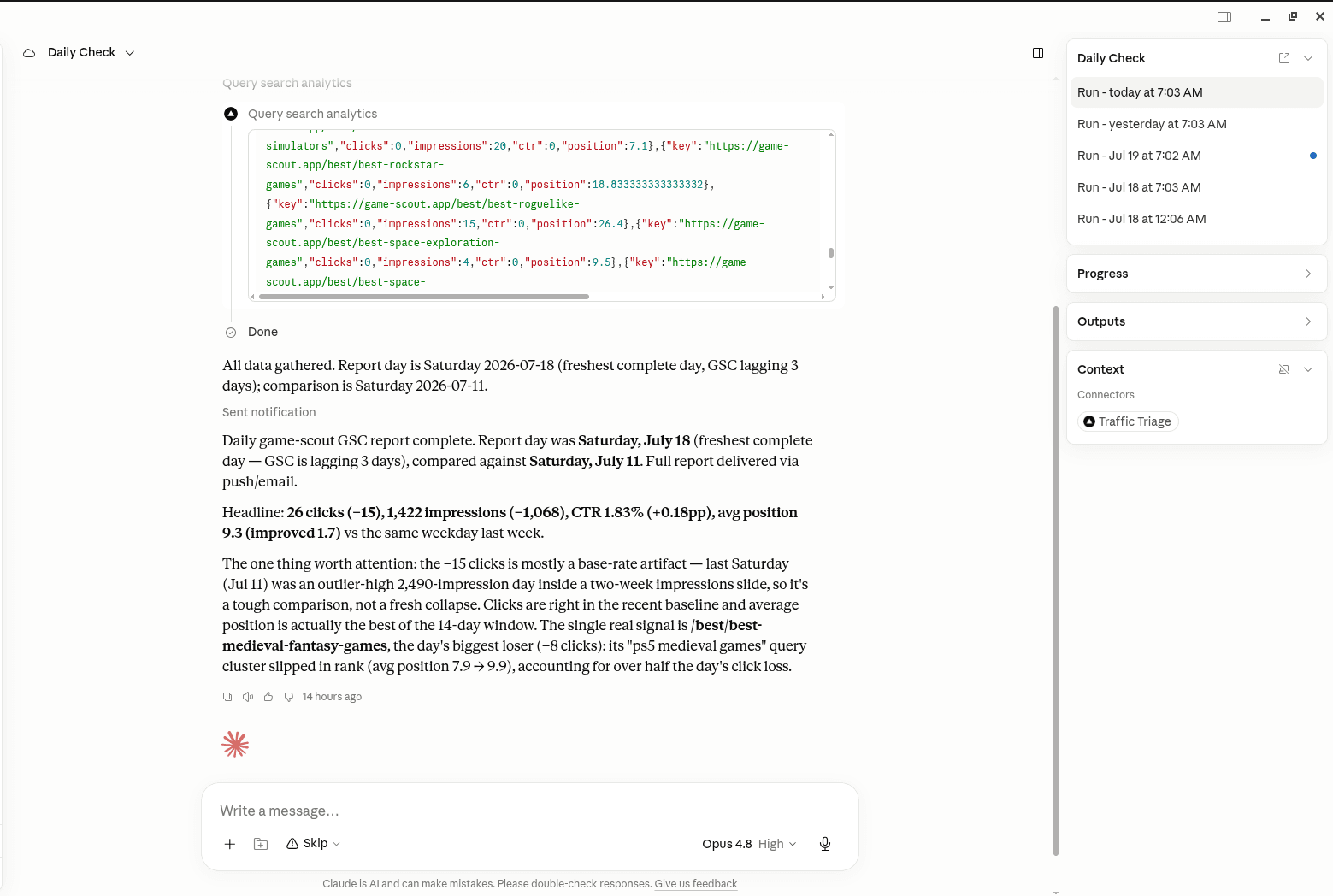
TrafficTriage plugs into Claude, Cursor, and ChatGPT. Your assistant runs the 8 checks, reads your Search Console data, and can even check your site every morning. Free account, no API key, nothing to install.