
 TrafficTriage
Do Pages With No Traffic Hurt SEO? 9,864 Pages Measured
By Ugur Saritepe · September 29, 2026
Pages with no traffic do not drag the rest of your site down the way the forum threads say. I can show you what they do instead. Over the 90 days to 2026-09-29, game-scout.app had 107 curated list pages and about 9,900 indexable catalogue pages. The 107 earned 5,466 clicks. The 9,900 earned 17.
The two page surfaces on one site
game-scout.app is my games site and my test bed. It has two kinds of page. The /best pages are curated lists with real editorial copy, a ranking method and per-game notes I wrote. The /gamepages are the catalogue: one page per game, built automatically from the game's store listing or a games database.
On 2026-09-27 I counted what is actually on them. There are 10,162 catalogue pages, 9,864 of them marked indexable, carrying a median of 162 words of store or database description. A typical one, the page for Killer Frequency, runs 468 words, and about 233 of those are the publisher's own blurb. Of the 10,162, only 951 carry any review sentiment and 36 carry an editorial take I wrote. Against that sit 107 curated lists covering 907 distinct games, plus 74 articles.
So by page count the catalogue is the site: 9,864 indexable pages against 107 curated lists and 74 articles. Fewer than one in ten of those catalogue pages carries a sentence of our own. That is the setup the forum question is really about, and I had never measured what it returned.
What each surface returned in 90 days
Three Search Console pulls on the same window, 2026-07-02 to 2026-09-29, filtered by URL path. Search Console lags two to three days, so the last two days of each are incomplete.
surface            pages    clicks   impressions   CTR     position
/best (curated)      107      5,466       254,426   2.15%        9.5
/game (catalogue)  9,864          17         2,893   0.59%       16.6
whole property                 5,912       306,463   1.93%        9.3
The catalogue is 0.29% of the site's clicks and 0.94% of its impressions, on about 99% of its indexable pages. The 107 curated pages produce 92.5% of the clicks.
One caveat on the catalogue row before anyone quotes it. The page-by-page pull stopped at Search Console's 250-row limit, so I cannot tell you how many of the 9,864 earned even one impression. The totals are exact; the row list is a sample. 17 clicks is also not zero: one page about a chemistry dating sim earned 4 of them.
What Google actually did with the 9,864
This is the part the SERP never covers. I inspected three catalogue URLs in Search Console on 2026-09-29, expecting to find them dropped. They are not dropped.
/game/killer-frequency-3085   Submitted and indexed   last crawl 2026-07-02   referring URLs 1
/game/slime-rancher-6039      Submitted and indexed   last crawl 2026-09-05   referring URLs 0
/game/4479                    Alternate page with proper canonical tag        referring URLs 0
All three allow crawling and indexing, all three fetch successfully, and on all three the canonical Google picked (the URL it treats as the real one) matches the URL the page declares for itself. The first two even show Review snippets and Breadcrumbs as detected rich results. Nothing is broken and nothing is being punished.
The interesting column is the crawl date. Killer Frequency was last crawled on 2026-07-02, which is 89 days before I looked. The page is fine. Google has simply stopped coming back to it. That is what it looks like when a page is kept but not valued: it stays in the index and falls out of the crawl rotation.
The second row is the one that annoys me. /game/slime-rancher-6039 collected 658 impressions at average position 5.2 and zero clicks in the same 90 days, with zero referring pages reported. Top five on page one, 658 chances, not one click. That is not a thin-content problem at all. That is a page ranking for a query it does not answer, or a title nobody wants to click, and it is a different diagnosis with a different fix.
What Google says the cost actually is
Two of the ten pages ranking for this question told me thin pages "dilute the perceived authority of your domain". Google's own SEO starter guide says the opposite in plain words: duplicate content is not a spam violation and carries no penalty, and what it does cost you is crawl budget and reader confusion. My three inspections are that sentence happening in front of me.
The same guide adds a threshold worth knowing: directory grouping starts to matter above roughly a few thousand URLs, because it lets Google learn how often each directory changes and crawl accordingly. With 9,864 pages under one path prefix, game-scout is well past that line, and /game is exactly the directory Google has learned not to hurry back to.
There is a real risk here, and it is a different one. Google's spam policies define scaled content abuse as mass-produced content without unique value, enforced by automated systems plus human review as needed, with ranking lower or not appearing at all as the consequence. That is a manual-action risk, not an authority-dilution effect, and it applies to intent and scale rather than to any page's word count. The helpful-content guidance (updated 2025-12-10) puts "mainly summarizing others without adding value" on its list of things to avoid, which describes 8,900 of my pages accurately.
It is not the word count
The median catalogue page carries 162 words of description. It would be easy to read that as a length problem and go add 300 words to each page. That is the wrong lesson.
The problem with the Killer Frequency page is not that 468 words is too few. It is that 233 of those 468 came from the publisher, so a reader who found the page learned nothing they could not have read on the store. The 951 catalogue pages that carry review sentiment are the same length and are not the same page. Length is a symptom people can count; whose words they are is the thing that matters.
How to check this on your own site
Two questions, in this order, and each has a cheap answer.
- Which of my pages return nothing? In Search Console, open Performance, switch to the Pages tab, set the window to 90 days and sort by clicks ascending. Pages with impressions and no clicks are one problem. Pages absent from the list entirely are a different one: they earned no impressions, so they are not competing.
- What has Google done with those pages?Paste one into URL Inspection. The line to read is not the verdict, it is the last crawl date. "Submitted and indexed" with a crawl date three months old means Google is keeping the page and has stopped checking it. "Crawled, currently not indexed" means it looked and declined. "Discovered, currently not indexed" means it has not even looked yet.
Good output on step 2 for a page you care about looks like a crawl date inside the last few weeks. Bad output is a crawl date older than your last meaningful edit to that page, which tells you the edit has not been seen.
Doing that by hand is fine for ten pages. At 10,000 it is not a task a person does, which is why I do it by asking. The pairing that matters here, every page's clicks next to its index state and its last crawl, is two different Search Console reports that nobody joins for you.
What we have not fixed
Three things, so nobody reads this as a finished story.
- We have not changed any of the catalogue. As of 2026-09-27 all 9,864 of those pages were still marked indexable, and nothing has been deleted, noindexed or rewritten since I counted them.
- We have not raised the 150-entry cap on our game sitemap, which I first wrote down on 2026-09-02 and named again on 2026-09-27, so the new catalogue pages each list introduces never reach a sitemap at all.
- Our own working notes on Google's crawl-budget documentation still describe game-scout as a 250-URL site, which is off by about forty times, and we have not corrected them.
The decision itself is also open. If I noindex the pages with no original prose, the rule to know is that noindex has to be a meta tag or an HTTP header and the page has to stay crawlable for Google to read it, which is the opposite of the robots.txt instinct most people reach for first.
What to do with this
If you have a large automated page surface and you are deciding whether to prune it, the order that fits the evidence above is:
- Split the pages into the ones with impressions and no clicks and the ones with no impressions. They are separate problems and only the first one is about titles and snippets.
- Check the last crawl date on a sample of the no-impression group. If Google has stopped returning, you have a crawl-attention answer already and no penalty to undo.
- Decide per group, not per site. Enrich the pages you can add something to, noindex the ones you cannot, and leave the rest. Deleting is the only irreversible option on the list.
- Do not start by adding words. Start by asking whose words are on the page.
This is one site, one 90-day window, and one page surface, so read it as a case rather than a law. Two of my earlier counts on the same property went the same way: 45 automated lists out-earned 34 hand-written articles by twenty to one, and ranked-set pages beat yes-or-no pages on click-through by a factor of twenty-six at the same rank band. The shape that keeps repeating is that page count is not the unit that earns anything. The rest of the AI-assistant SEO series works through my own numbers the same way. If you want the upstream check first, the free Triage Report tells you whether a single page is crawlable and indexable at all, which settles a lot of these questions before any of the above matters.
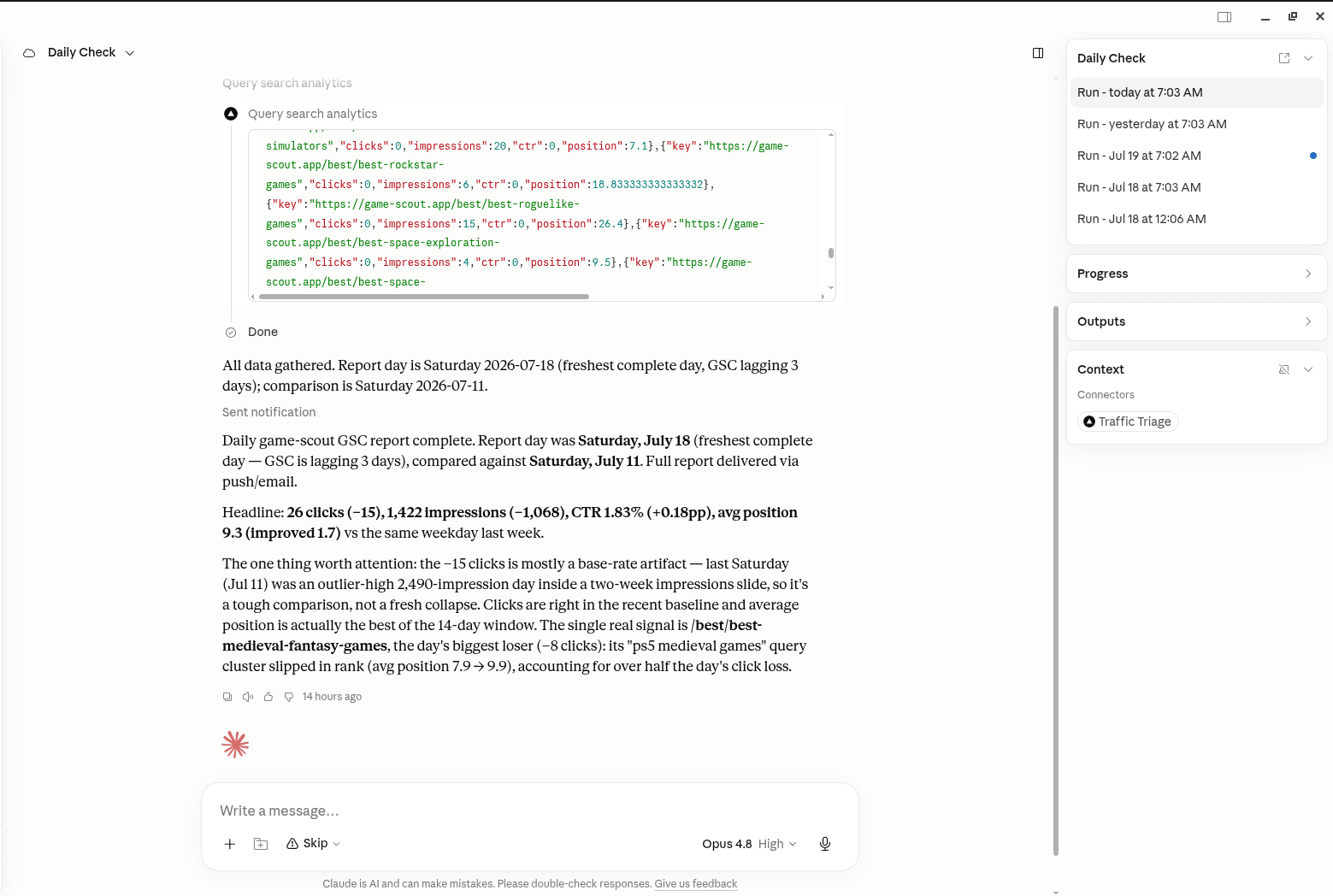
I have this result from adsense lets brainstorm what can we do about low value content. Lets also investigate google docs to understand what is best way to go forward
That is what I typed on 2026-09-27 that started this. The trigger was an ad-network rejection rather than a ranking drop, which is worth being honest about: the search numbers above were not what made me look. They are what I found when I did.
FAQ
Do pages with no traffic hurt SEO?
Not as a penalty. Google's own starter guide says duplicate content is not a spam violation and carries no penalty, and that what it actually costs you is crawl budget. On game-scout.app, the 9,864 catalogue pages that returned 17 clicks in 90 days were still indexed and still allowed; the measurable cost was that Google stopped coming back to them, not that the 107 pages earning the clicks ranked worse.
Should I delete pages that get no traffic?
Deleting is the most expensive option and usually the wrong first one. A page with no clicks but real impressions is ranking for something and losing the click, which is a title and snippet problem. A page with no clicks and no impressions is not competing at all, and for that one your choices are enrich it, noindex it, or leave it. Measure which of the two you have before you delete anything.
How many words does a page need to avoid being thin?
There is no number, and looking for one sends you the wrong way. Our catalogue pages run a median of 162 words of description, but the problem is not the 162: it is that those words came from the game's own store listing, so the page adds nothing a reader could not get from the source. A 200-word page with one original observation is not thin. A 2,000-word page of restated press copy is.
Does Google penalise a site for having thousands of thin pages?
Ranking lower or not appearing at all is the documented consequence of scaled content abuse, which Google defines as mass-produced content without unique value, enforced by automated systems plus human review. That is a real risk at scale and it is separate from the ordinary case, where Google simply declines to spend crawl attention on pages that are not worth keeping fresh.
You cannot decide what to prune from a page count. You decide it from what each page returned and what Google did with it. Create a free account, connect Search Console, and the Pages view lists every tracked page with its clicks and impressions against the previous fortnight, its internal link count, its last crawl date and which on-page checks it fails, in one table you can sort by the column you care about. With the MCP serverconnected your assistant reads the same table, so "which pages have earned nothing and have not been crawled in two months" is a question you ask rather than a join you build.
In your AI assistant
Ask your AI about your own site
TrafficTriage plugs into Claude, Cursor, and ChatGPT. Your assistant runs the 8 checks, reads your Search Console data, and can even check your site every morning. Free account, no API key, nothing to install.