
 TrafficTriage
Do Supporting Articles Help SEO? What 34 of Ours Earned
By Ugur Saritepe · September 6, 2026
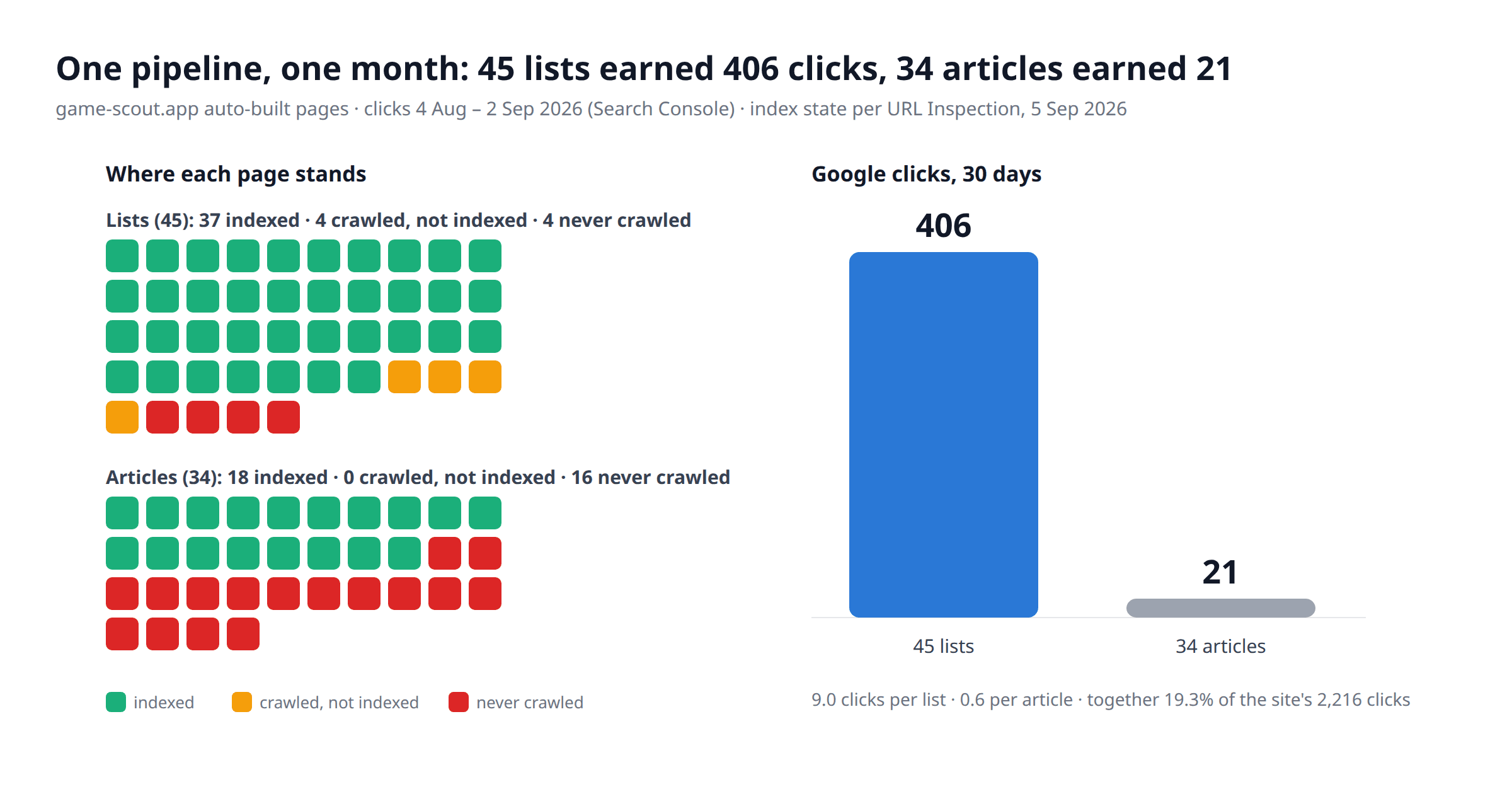
Every ranked answer to this question says yes, from theory. Here is one site's measured month instead. My games site auto-publishes curated lists and supporting articles from the same pipeline. In the 30 days to 2 September 2026, the 45 lists earned 406 Google clicks; the 34 articles earned 21. That gap changed what we build articles for.
The table that answered it
The question got a real answer because I asked for a boring table. What I typed to the assistant on 5 September:
can you make a table with all the lists and articles that are created by auto pipeline. Make a table with when we merge it, index status and last crawl time, impression and clicks
Build the per-page table: merge date, index state, last crawl, impressions, clicks.
79 auto-built pages from git add-commits: 45 lists, 34 articles
clicks per page, 30d window 2026-08-04 to 09-02
          pages  indexed  crawled-not-indexed  never crawled  clicks/30d
lists        45       37                    4              4         406
articles     34       18                    0             16          21
Auto content is 19.3 percent of the site's 2,216 clicks, on 33,264 impressions. Articles are where the pipeline fails: 16 of the 20 never-crawled pages are articles.
Method, so you can distrust it properly: pages were classified as auto-built from the git commits that added them, and the five PC lists from hand-run pilot builds were excluded. Index state is Google's URL Inspection per URL, pulled on 5 September. Clicks are Search Console per page for the 30 days to 2 September. Per page, that is 9.0 clicks per list and 0.6 per article, a roughly 19x gap.
Articles fail earlier than you think: at crawling
The click gap starts before ranking. Google indexed 37 of the 45 lists, an 82 percent rate, and 18 of the 34 articles, 53 percent. Not one article sat in the "crawled, currently not indexed" state that gets all the forum attention. The articles Google skipped, it skipped entirely: 16 of them had never been fetched, and they had been live between 18 and 49 days when we checked. If your articles earn nothing, check whether Google has even read them before you rewrite a word. That is the same lesson as the six weeks Google stopped indexing our new pages, where links, not requests or pings, were what moved pages into the index.
Two honesty notes on that table. Absorption takes four to six weeks on this site, and the June and July cohorts sit at 80 to 100 percent indexed against August's 53, so the article number will improve some on its own. And URL Inspection is unstable for never-crawled pages: one list returned "Discovered, currently not indexed" and "URL is unknown to Google" within minutes of each other. Single inspections are snapshots, not verdicts.
The format that never earned: 20 comparison articles, 8 clicks
Inside the article cohort, one format did most of the damage. The pipeline had built 20 "X vs Y" comparison articles. Their combined 30-day take: 8 clicks on 2,282 impressions. The pattern was visible by 6 August, when a 12-page sample showed 2 clicks, and the explanation held up: the search results answer "X vs Y" inline and park the page on page 2. Sixteen impressions per click buys a lot of nothing.
The embarrassing part is what happened next, and it is the reason I trust this table more than my own process. We graded the stop-building-comparisons rule as a hit in the 6 August cycle review, wrote "encode the rule into the skill" as an action item, and never did it. The build skill still listed comparisons as a first-class format a month later, and the 5 September session found it still there. Both content rules we had graded as hits were encoded only on 5 September, 41 days after the first grade. We have not removed or reworked those 20 comparison pages; they are live as I write this.
Indexed and still invisible: 7 pages Google declines to serve
The table also killed a comfortable assumption. I had been treating zero impressions as a proxy for not indexed. URL Inspection says otherwise: 7 pages are indexed and still earn zero impressions, and four of them had been crawled the same day we checked. Google has these pages and chooses not to show them. No amount of waiting, pinging, or resubmitting fixes that, because it is a relevance problem, not a crawl problem. It is the far end of the spectrum that starts at impressions without clicks: here there are not even impressions. We have not fixed those seven pages yet; the finding is three days old.
So what are supporting articles for?
Here is where I landed, typed in the same session, after reading the table:
For me articles are more like support pillar. I am not putting them to get clicks from gsc but I am trying to improve time user spend on the site with support articles but also increase authority for search engines
That is a real job, but it is a different job, and it changes the contract. A support article does not need to win a search result. It needs to be linked from the pages that do win, cover a question those pages cannot stop for, and give a reader a reason to stay. The next day we rebuilt the article system around that role: every article is anchored to the games it covers, links are derived from the cluster structure instead of hand-placed, and contract tests enforce the support fields. That redesign shipped on 5 and 6 September. It is too new to have results, and I am not going to pretend otherwise; the honest claim today is only that the 34 articles now have a defined job they can be measured on.
What I will not claim is the version the ranked answers sell: that supporting articles raise your site's authority in some general way that pays back in rankings. Maybe. Our site's clicks grew 65 percent over the same 30 days for reasons we can trace to lists, hubs, and links, not to articles. If you cannot measure the support effect, at least measure the cost: every never-crawled article is build effort Google never saw.
Check what your own articles earn
The whole diagnosis above is one table, and it takes three asks if your data is connected to an assistant, the way the rest of my routine runs. 1."List my pages by type with clicks for the last 30 days." Absence from Search Console rows means not visible, never zero, so keep the totals row. 2."Which of these has Google never crawled?" That is URL Inspection per page, and it is the question nobody asks about articles. 3."Per class: clicks per page, and never-crawled count." The answer tells you whether you have a click engine, a support layer, or a pile Google has not read. The other assistant-side workflows follow the same pattern. If you just want the site-level basics checked first, the free triage report runs eight checks from a URL alone, no account needed.
FAQ
Do supporting articles help SEO?
Not as click earners, in our measured case. Over 30 days, 45 auto-built list pages on our games site earned 406 Google clicks while 34 articles earned 21, and 16 of those articles were never crawled at all. Articles still carry internal links, cover subtopics the money pages cannot, and give readers somewhere to go next. Treat them as support for the pages that do earn clicks, and measure them on that job, not on clicks.
Should I delete blog posts that get no clicks?
Not before you know why they get none. Check three states per page: never crawled means Google has not fetched it, so links to it are the fix, not deletion. Crawled or indexed with zero impressions means Google read it and declines to serve it, which is a relevance problem. Only a page that serves no reader, earns no clicks, and supports no other page is a deletion candidate. We kept our 34 low-click articles and reassigned them to a support role instead.
How do I check whether Google has crawled my articles?
URL Inspection in Search Console reports the state per URL: indexed, crawled but not indexed, discovered but not crawled, or unknown. Run it on each article, or use a tool that batches it. One warning from our run: results for never-crawled pages are unstable, and the same URL returned two different states within minutes. Treat a single inspection as a snapshot, and pair it with per-page impressions before concluding anything.
See this table for your own site.Create a free account, add your site, and the Pages view in the dashboard shows every tracked page's index state, last crawl, Google clicks, and internal links in one table, the same columns this post is built on. Your assistant can read it too, through the MCP server.
In your AI assistant
Ask your AI about your own site
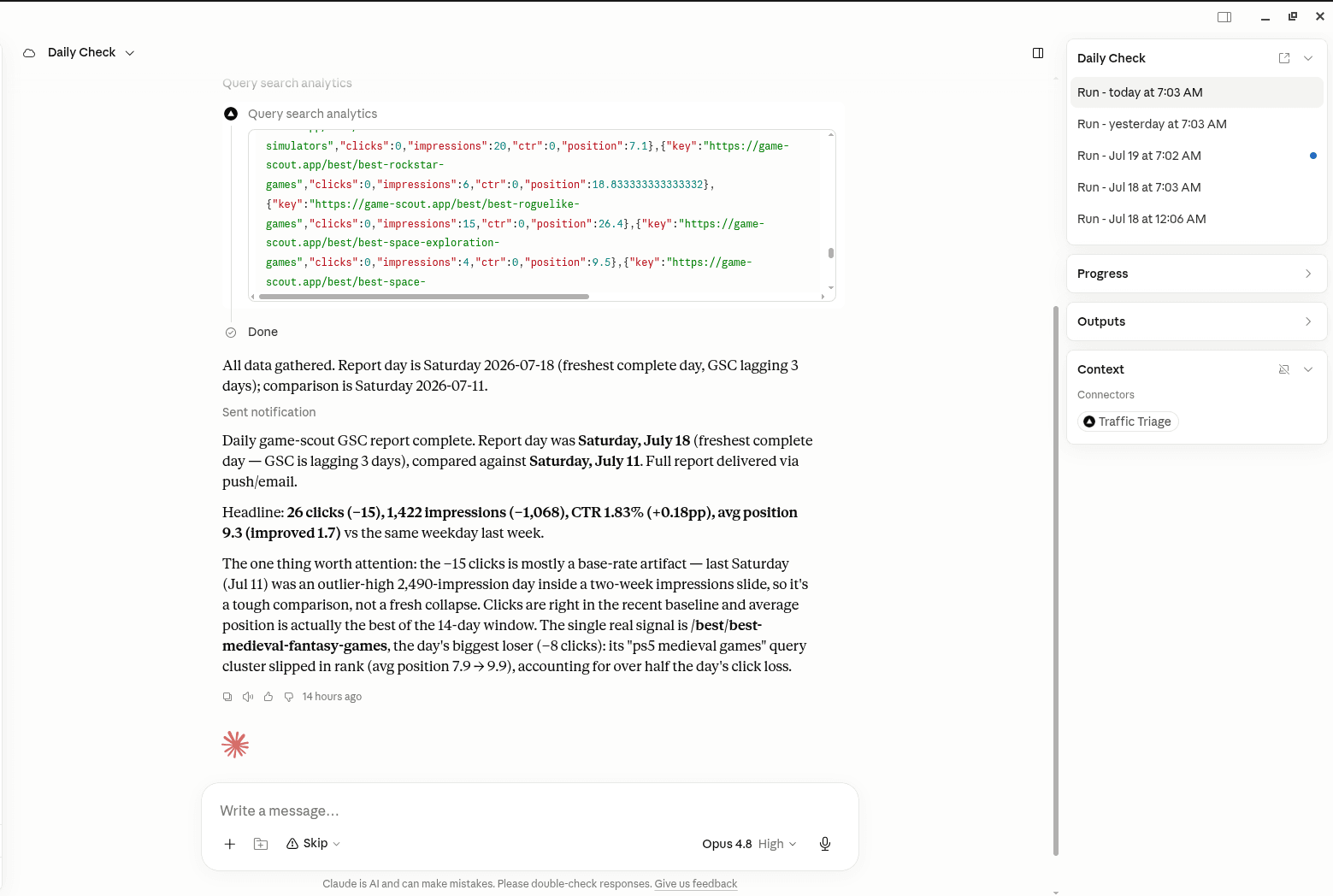
TrafficTriage plugs into Claude, Cursor, and ChatGPT. Your assistant runs the 8 checks, reads your Search Console data, and can even check your site every morning. Free account, no API key, nothing to install.