
 TrafficTriage
How to Prioritize SEO Tasks: One Graded Bet at a Time
By Ugur Saritepe · September 14, 2026
How to prioritize SEO tasks: pick one bet per cycle, give it a numeric target and a re-check date, and grade it HIT or MISS before you pick the next one. That is the whole method. We have run it on our own site for seven weeks, five cycles, every grade on record, including the cycle whose diagnosis the next grade disproved.
The question that started the log
game-scout.app is the games directory I run and write about openly. By late August 2026 it had 85 lists, 51 articles, and the standard problem: more plausible tasks than time, and no way to tell which mattered. This is what I typed:
How does seo engineer work? How does person select what to work on? How priotize and pick. Can we make a study in our game-scout use case?
The benchmark found the loop already existed in pieces: an append-only cycle log with one graded bet per cycle, running since 26 July. The study wrote down its five rules, and this post is those rules with their grades attached.
The loop, in five rules
- One bet per cycle, graded before the next. Each cycle opens with a baseline, states one hypothesis, sets a numeric target with a date, and the previous bet gets its HIT, MISS, or PARTIAL first. The log is append-only; the only permitted edit is flipping PENDING to a verdict.
- Impact is computed, never asserted. A candidate task is sized by its trapped clicks: impressions times the gap between the CTR its position band should earn and the CTR it gets. Tasks that cannot produce a number go to the back.
- Rank problems and snippet problems split first. Past position 10 is a rank problem; inside the top 10 with CTR under band is a snippet problem, checked for query-to-title mismatch before any rewrite.
- Edited pages lock for about 21 days. Grades come from clean 14 to 30 day windows, because search data needs time to settle and a 90 day window buries the change.
- New ideas go to LATER. Never to NOW. A list is only built after a demand gate, roughly 200 impressions already arriving on the topic or eight or more validated titles in the niche.
Three bets, three grades
26 July: steer list building to tight niches. The site's own 30 comparable list pages split cleanly: 16 tight-niche lists (detective, trucking, medical) earned 38.9 clicks per page at position 8.5, while 14 broad-genre lists (strategy, action, open-world) earned 12.4 at position 14.0, a 3.1x gap. The bet: 5 of the next 6 automated builds tight-niche, and site clicks per 30 days from 932 to at least 1,050 by 16 August. Graded HIT: 5 of 6 complied and clicks reached 1,196. The grade carried a caveat that set up the next cycle: 17 of the 18 newest lists had zero Google impressions, so selection was fixed but indexing now gated everything.
6 August: steer articles from comparisons to tips. Same split, different content class: 12 comparison articles held 1,102 impressions and 2 clicks, while 11 practical tips articles held 4,718 impressions and 61 clicks. The bet: 3 of the next 4 articles in the tips class, and non-flagship article clicks from about 6 to at least 10 per 30 days by 5 September. Graded HIT at 57 clicks, 5.7 times the target. The comparison class later got its own post-mortem.
16 August: the bet whose diagnosis died. With 17 of 18 new lists unindexed and internal links, sitemap discovery, and manual indexing requests all already in place, the log concluded that authority was the binding constraint and assigned a link-building sprint: three new referring domains, six of the 18 lists indexed, and clicks at 1,250 or better by 6 September. Graded 5 September: PARTIAL, with the mechanism falsified. Referring domains: zero, a MISS. Lists indexed: 8 of 18, a HIT. Clicks: 2,216, a HIT by 77%. The indexing resolved with no off-page work at all; the domain simply absorbs new URLs at roughly 44% per six weeks. The authority diagnosis was wrong, and the loop is what caught it: a framework that never grades its own bets keeps its wrong diagnoses forever.
What the grades changed
The falsified bet cut the link-building lever's confidence score from 7 to 4 in the log, so it stopped outranking other work. The grades also exposed two of our own failures. Two consecutive cycles listed "encode the winning rule into the automation" as an action and neither cycle did it, which is how two broad-genre lists slipped through a tight-niche policy; the rules were finally encoded on 5 September. And the freezes were over-broad: for weeks the log froze whole clusters around any page under measurement, until the owner pushed back and the rule narrowed to the edited page only:
I dont want to freeze clusters. I am freezing lists/articles because they are new page but dont want to freeze cluster we can add any of them.
The lock now applies to an individual edited page inside its 21 day window, never to its cluster. The differential read against a control cohort survives link changes around it.
We never ran the link-building sprint we assigned ourselves; it stayed unexecuted for 20 days across three cycles, and the next grade showed the indexing problem it was meant to fix had resolved without it. The current bet, opened 5 September, restarts list production at three per week with a target of 2,700 clicks per 30 days by 3 October. As of 14 September the 28 day window reads 2,514 clicks on 122,548 impressions at position 9.1, against 1,316 clicks on 66,321 impressions the 28 days before.
Run the loop on your own site
- Pull 28 days of clicks, impressions, CTR, and position from Search Console. That is your baseline; write it down with the date.
- Size every candidate task with the trapped-clicks formula and sort. Split rank problems from snippet problems so each candidate names the fix type it deserves.
- Pick exactly one bet. State the target as a number with a date two to four weeks out, and park everything else in a LATER list.
- On the date, grade it HIT, MISS, or PARTIAL against the written target, adjust that lever's confidence, and only then pick the next bet.
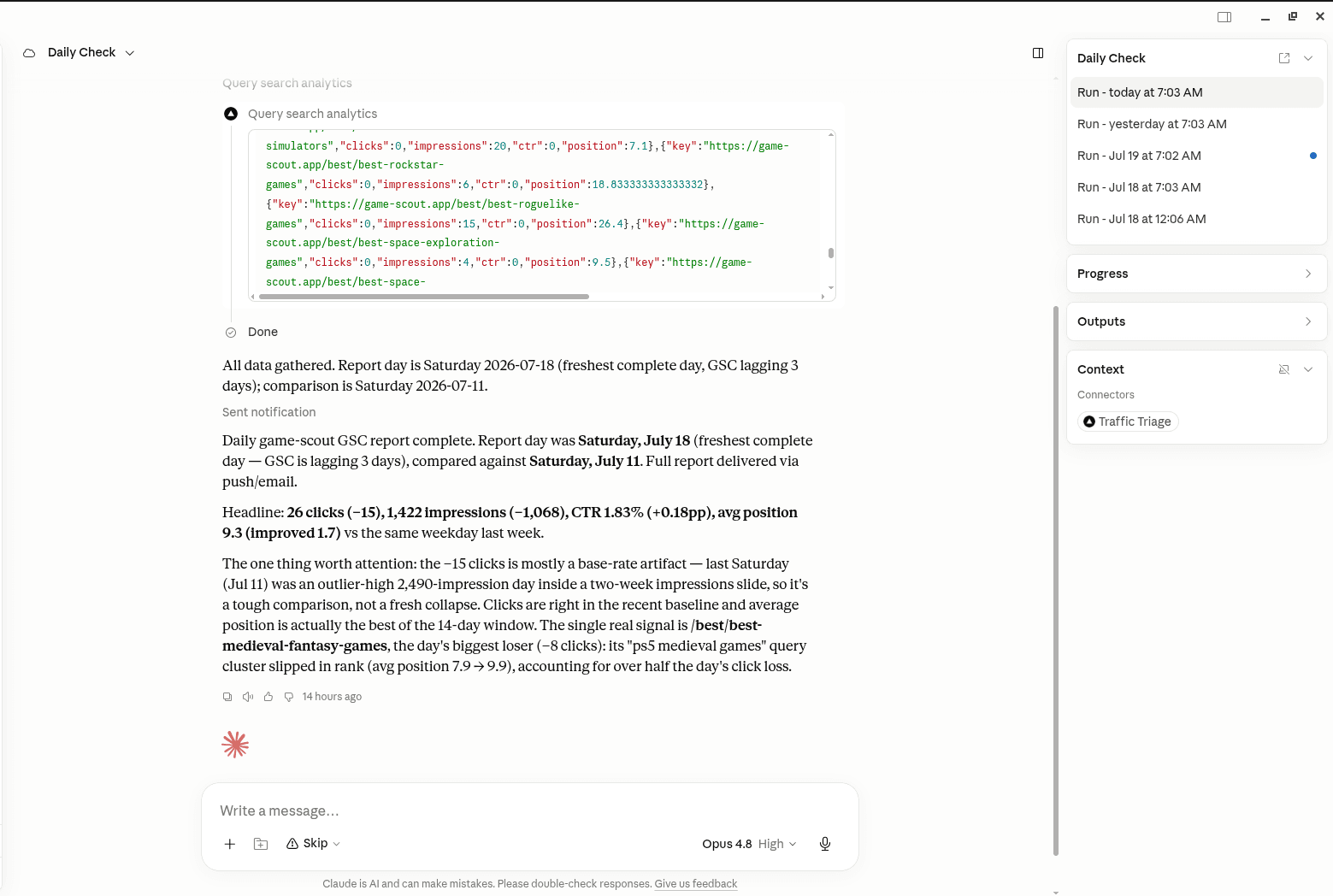
Good output looks like a log entry that embarrasses you occasionally: a MISS on record, a confidence score cut, a diagnosis withdrawn. Bad output is a strategy document with no dates and no grades, which is what most prioritization frameworks produce, because nothing in them ever gets scored against a number set in advance. We run the pulls and the log through an assistant connected to Search Console, which is also how the daily five-minute check under this weekly loop works.
This post is part of our AI-assistant SEO series, written from the SEO work we do on our own sites. For a five-minute check of the basics on any site, the free triage report runs eight checks from a URL alone, no account needed.
FAQ
How do I prioritize SEO tasks on a small site?
Pick one bet per cycle, give it a numeric target and a re-check date, and grade it HIT or MISS before you pick the next. We have run this loop on game-scout.app since 26 July 2026: five cycles, every bet graded against a number set in advance, and monthly clicks went from 932 at the 26 July baseline to 2,514 in the 28 days to 14 September 2026, while the log shows exactly which bets earned it.
How do I estimate the impact of an SEO fix before doing it?
Compute trapped clicks instead of asserting importance: impressions times the gap between the CTR your position band should earn and the CTR the page gets. That one formula ranked our whole backlog. It also gets checked later: one projection of +146 clicks from a retitle died when the query split showed the reachable head was already converting.
How do I know if a page needs better content or a better title?
Split rank problems from snippet problems before choosing a fix. A page past position 10 has a rank problem, and titles rarely move it; a page inside the top 10 with CTR below its band has a snippet problem, and content depth rarely moves that. Check for a query-to-title mismatch first, because the split decides which fix is even a candidate.
How long should I wait before judging an SEO change?
We lock every edited page for about 21 days and grade in clean 14 to 30 day windows. Shorter reads are dominated by crawl timing and query noise; a 90 day window hides the change you made. The lock applies to the page you edited, not its whole cluster. We froze whole clusters for weeks before deciding, on 5 September 2026, that only the edited page needs the lock.
Grade your bets instead of collecting them. Create a free account and the MCP server lets your assistant log each bet with log_prediction, target and date attached, and grade it against your own Search Console rows when the date arrives.
In your AI assistant
Ask your AI about your own site
TrafficTriage plugs into Claude, Cursor, and ChatGPT. Your assistant runs the 8 checks, reads your Search Console data, and can even check your site every morning. Free account, no API key, nothing to install.