
 TrafficTriage
Updated a Page and Impressions Dropped: Two Real Outcomes
By Ugur Saritepe · September 8, 2026
You edited a page and its impressions fell off a cliff in Search Console. On 13 June 2026 we changed two list pages on game-scout.app, our own site, on the same day. One went near zero for nine days and came back stronger. The other collapsed a month later and never recovered. Here is the daily data and the decision rule that falls out of it.
Two edits on the same day, two opposite endings
Both pages are curated game lists. On 13 June 2026 we broadened best-detective-games from 13 to 15 titles, and we re-curated the selection on best-local-coop-games. The dates come from git, which is what makes this comparison possible at all. Everything below is from Search Console's daily per-page series, pulled 8 September 2026 for the window 1 June to 5 September.
- best-detective-games: quiet for nine days, then recovery. Now 420 clicks and 8,558 impressions in the last 28 days at position 6 to 7, against roughly 10 impressions a day before the edit.
- best-local-coop-games: improved for a month, collapsed on 12 July, never came back. Now 3 clicks and 844 impressions in the last 28 days at position 20 to 35, against roughly 200 a day at its July peak.
The page that went quiet for nine days
The detective list's impression row after the 13 June edit is the pattern that panics people:
best-detective-games, impressions per day
Jun 4-11:   19 16 10 15  5  8 12  5
Jun 12-20:   0  4  3  0  2  0  1  1  4
Jun 21-27:  33 32 35 19 74 75 121
Fifteen impressions across nine days, on a page that had been earning about ten a day. If we had judged the edit in that window we would have called it a disaster and reverted. We did neither, and from 21 June the series came back above its old baseline and kept climbing: by early September the page was earning 300 to 500 impressions a day at position 6 to 7, from position 13.9 before the edit. The quiet stretch was Google re-evaluating the changed page, not a verdict on it. Google's own core updates page describes re-assessment the same way: changes take time to be re-scored, and recovery is measured in weeks, not days.
One honest caveat from our own record: 21 June was also a deploy and sitemap-resubmission day for the whole site, so the exact recovery date has a confound. The shape of the dip does not.
The page that looked fine for a month, then fell
The local co-op list is the trap case. After the same-day edit it did not dip at all. Through early July it was the healthier page: around 200 impressions a day at position 9 to 11, its best stretch ever. Then:
best-local-coop-games, impressions per day
Jul 8-11:  167 151 179 236
Jul 12-15:  77  23  31  27
Sep 2-5:     8  19  24  24
If you only knew that the page was edited in June, the obvious story is that the edit killed it. The dated record says otherwise, three times. First, the collapse started 12 July, a month after the edit; re-evaluation dips do not wait a month. Second, our whole site lost 38 percent of weekly impressions in the same 12 to 13 July window, so part of the fall was never about this page. Third, the page fell much harder than the site and stayed down while the site recovered, which points at the queries themselves: Google re-shuffled who it shows for the broad co-op searches this page lives on, and it demoted us from position 9 to the 20s and 30s.
We did try to fix it. The page got a rewritten intro that answers the query in its first lines plus internal links on 21 June, and its hook was rewritten again on 23 July. Neither brought the series back; as of 8 September it still earns under 30 impressions on most days. We have not tried reverting the June re-curation, and the honest reading of our own data is that we cannot fully separate the edit, the site-wide drop, and the reshuffle. Without the dated change log we could not even have listed the candidates.
How to tell which drop you have
The whole diagnosis runs on one thing: knowing exactly when the page changed. With that date, work down this list and stop at the first match.
- Drop starts within days of the edit.Check the page's daily impressions in Search Console (Performance, filter by page, group by date). Good sign: the fall begins 0 to 3 days after your change and the position column goes blank or erratic on the quiet days. That is re-evaluation. Wait two to three weeks before touching the page again.
- The site fell on the same day. Remove the page filter and read the site-wide series for the same window. If the property dropped together, your edit is not the story; you are looking at an algorithm update, a serving change, or a technical problem. Our 12 July window took the site down 38 percent; no per-page fix was going to undo that.
- Drop starts weeks after the edit.Not the edit's echo. Compare position against impressions: if position worsened and stayed worse, Google re-ranked the page or the query set around it. If position held while impressions fell, the queries themselves lost volume or you lost eligibility for them.
- Quiet past 60 days. Treat the re-scored state as the new baseline. Now reverting, rewriting, or retargeting are all on the table, and each one restarts the clock, so change one thing and date it.
Dating changes is the entire method
Nothing above needed anything exotic: a git log and the daily Search Console series. What it did need was discipline about dates, including the discipline of not re-judging a page on a window dominated by its old version. From the completed log in our own repo on 21 June, the day the detective list recovered:
Roster + title HELD, selection NOT re-curated: the 30-day GSC window is still ~93% old-page history
That is the mindset this post is really about: the 30-day averages Search Console shows you by default are mostly history, and only the daily series lined up against dated changes tells you what an edit actually did. It is the same page-level habit we used when our indexed count dropped and when a page had impressions but no clicks, and it is the backbone of how we run SEO from an assistant and the other Search Console workflows we have written up. If you suspect the drop is technical rather than editorial, the free triage report rules out the eight structural causes from a URL alone.
FAQ
Why did my impressions drop after updating a page?
Usually because Google is re-evaluating the changed page. After a recrawl, rankings can go quiet for days while the new version is re-scored, and the impression row in Search Console falls with them. On our own site a page went from around 10 impressions a day to 15 total across nine days after an edit, then came back above its old baseline. A dip that starts within days of the edit and recovers inside a few weeks is the normal pattern, not a penalty.
How long does Google take to re-evaluate an updated page?
Google publishes no number. In our measured case the quiet stretch lasted about nine days: the page was edited on 13 June 2026, impressions ran near zero from 12 to 20 June, and recovery started on 21 June. Google's core updates documentation says re-assessment after broad updates can take until the next update rolls out, so weeks to months is possible for bigger swings. Days to a few weeks is typical for a single-page edit.
Should I revert a content update if impressions dropped?
Not in the first two weeks. The post-edit dip is expected, and reverting during it just triggers another re-evaluation. Reverting becomes worth considering when the drop starts well after the edit, persists past 60 days, or the page's position worsens and stays worse. Before deciding, check your site-wide impression series for the same window: if the whole site fell on the same day, the page's drop was never about your edit.
Get the change dates without keeping a log by hand. Create a free account and track your key pages: TrafficTriage snapshots each one on a schedule, records what changed and when, and keeps it next to your Search Console clicks and impressions, so the next drop lines up against a dated change instead of a guess. Your AI assistant can read the same history through the MCP server.
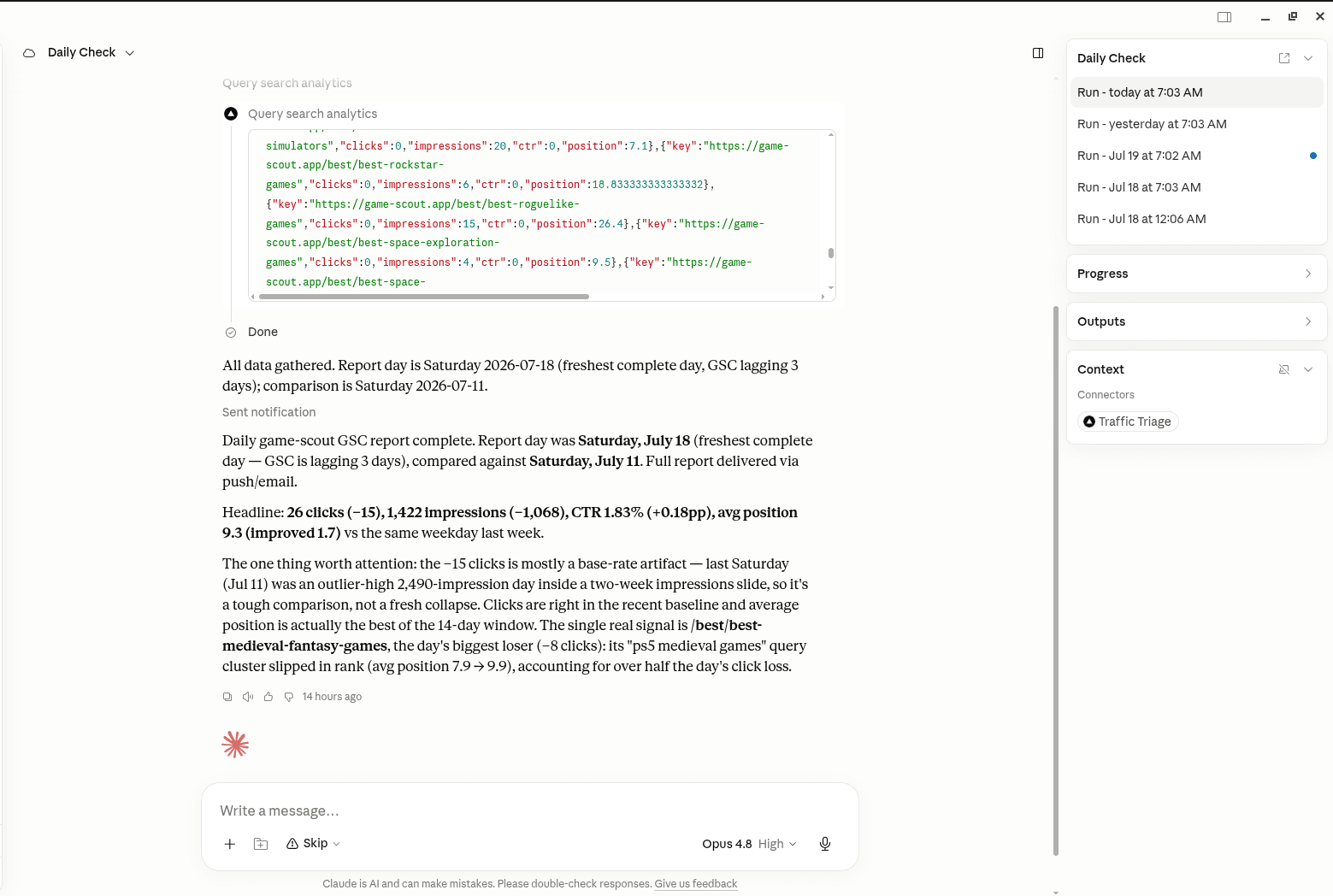
In your AI assistant
Ask your AI about your own site
TrafficTriage plugs into Claude, Cursor, and ChatGPT. Your assistant runs the 8 checks, reads your Search Console data, and can even check your site every morning. Free account, no API key, nothing to install.